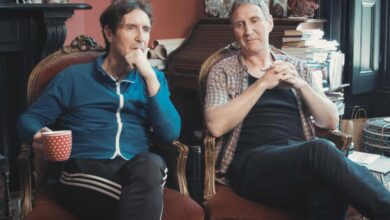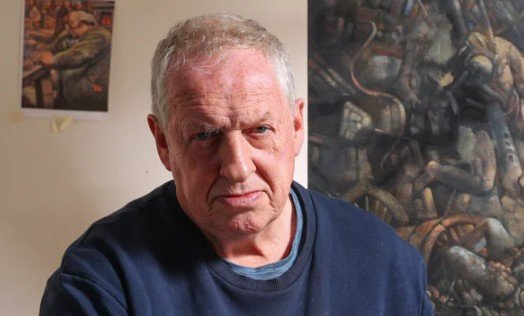
Peter Howson, the renowned Scottish painter, stands as one of the most powerful and provocative figurative artists of modern Britain. His work transcends ordinary artistic boundaries, capturing the struggles of humanity, the raw edges of society, and the spiritual conflicts of the soul. Known for his bold, muscular figures and gritty realism, Peter Howson’s art reflects the emotional turbulence and unfiltered truth of human experience. Through war, addiction, redemption, and faith, his journey as an artist has been as dramatic as the imagery he paints.
Early Life and Education
Peter Howson was born in London in 1958 to Scottish parents. His family moved to Prestwick, Ayrshire when he was still a child, and it was there that his fascination with art began. From a very young age, he showed an extraordinary ability to translate emotion into visual form. At six years old, his grandmother gave him his first set of oil paints, and his early experiments hinted at the emotional depth that would later define his career.
He enrolled at the Glasgow School of Art in the mid-1970s, joining an environment that would nurture some of Scotland’s most notable contemporary painters. However, Howson’s time there was far from straightforward. He struggled with the academic constraints of art education, preferring to paint directly from his raw emotions and personal observations. After a brief departure and a short period in the army, he returned to art school, where he began to shape his distinctive, hard-edged figurative style.
The Rise of a Unique Artistic Voice
By the 1980s, Peter Howson had become a central figure in what critics later called the “New Glasgow Boys” movement — a resurgence of figurative painting that emerged in defiance of minimalism and conceptual art. His peers included painters like Ken Currie and Adrian Wiszniewski, but Howson’s work stood apart due to its sheer emotional force.
His early paintings focused on Glasgow’s working-class men: muscular, weary, and often trapped in cycles of violence or despair. These characters were not idealised heroes but raw reflections of reality. His masterpiece The Heroic Dosser (1987) epitomised this period — a monumental portrayal of a homeless man depicted with dignity and strength, challenging societal neglect. Through such works, Howson demonstrated his ability to uncover beauty within brutality and humanity within hardship.
War and Witness: The Bosnia Period
The early 1990s marked a dramatic turn in Howson’s career. In 1993, he was appointed as Britain’s official war artist for the conflict in Bosnia. The experience profoundly changed him, both as an artist and as a person. Confronted with scenes of extreme violence and suffering, Howson began to produce paintings that depicted the horrors of war in all their visceral reality.
His works from this period are deeply unsettling yet profoundly moving. They do not glorify war; instead, they expose its inhumanity and moral collapse. In canvases filled with twisted figures, shattered bodies, and faces frozen in anguish, Howson captured what many photographers could not — the psychological and spiritual devastation of conflict. These paintings cemented his reputation as a fearless truth-teller, unafraid to confront the darkest aspects of the human condition.
The Bosnia period also became a personal crucible. The trauma he witnessed exacerbated his battles with addiction and mental health, leading him into years of inner turmoil. Yet, from this suffering emerged an artist whose work gained new spiritual depth.
From Despair to Redemption
Howson’s later life tells a story of redemption and faith. After years of substance abuse and breakdowns, he underwent a spiritual transformation around the turn of the millennium. His conversion to Christianity reshaped not only his worldview but also his art. Religious themes — crucifixion, redemption, sin, and grace — began to dominate his paintings.
However, Howson’s treatment of these themes was anything but traditional. His Christ figures are often muscular, battered, and bleeding, symbolising not just divine suffering but human endurance. Through these works, he explored his own spiritual struggles, transforming his pain into a form of visual confession. Paintings such as The Last Supper and Stations of the Cross illustrate this blend of violence and faith, darkness and light — a paradox that defines his entire body of work.
Artistic Style and Technique
Peter Howson’s paintings are instantly recognisable. His figures, sculpted with exaggerated musculature and stark outlines, resemble heroic statues that have been weathered by time and tragedy. The palette often leans towards earthy tones — ochres, browns, blacks, and reds — enhancing the weight and intensity of the subjects.
He draws inspiration from Expressionism and classical realism, merging them into a style uniquely his own. The exaggerated physicality in his figures reflects influences from artists like Käthe Kollwitz and Max Beckmann, yet his themes remain deeply rooted in Scottish social realism. His brushwork is vigorous and unrestrained, conveying motion and emotion in every stroke.
Lighting also plays a critical role in his compositions. Harsh contrasts between light and shadow evoke theatrical tension, symbolising the constant struggle between good and evil, strength and vulnerability. This interplay makes his paintings not just visual experiences but emotional confrontations.
Themes: Masculinity, Suffering, and Faith
Three recurring themes dominate Peter Howson’s art — masculinity, suffering, and faith.
Masculinity
Howson’s depiction of men is both celebrated and misunderstood. His muscular subjects might seem aggressive at first glance, yet they embody fragility beneath the surface. These are men stripped of glamour — dockers, labourers, soldiers, and wanderers — caught in moments of despair or reflection. Through them, Howson challenges toxic masculinity and exposes the vulnerability of the human spirit.
Suffering
Pain is a constant companion in his art. Whether depicting war victims, addicts, or himself, Howson uses suffering not as spectacle but as truth. His figures bear the weight of emotional and physical scars, serving as mirrors for the viewer’s own humanity.
Faith
Spiritual symbolism pervades his later works. Crucifixions, angels, and demonic forms recur, representing the eternal battle between salvation and sin. His paintings remind us that faith is not about perfection but perseverance — a belief forged in struggle.
Recognition and Exhibitions
Peter Howson’s contribution to modern art has been recognised across the world. His paintings are part of major collections, including the National Galleries of Scotland, the Imperial War Museum, and numerous private collections. He was appointed an Officer of the Order of the British Empire (OBE) in 2009 for his services to the arts.
In 2023, the Edinburgh City Art Centre hosted a major retrospective titled When the Apple Ripens: Peter Howson at 65, showcasing decades of his work and tracing his evolution from gritty social realism to spiritual introspection. Critics praised the exhibition for its emotional honesty and technical mastery, reaffirming Howson’s status as one of Britain’s most significant living artists.
Personal Life and Influence
Peter Howson’s life has been as tumultuous as his art. He has spoken openly about his struggles with addiction, his recovery, and his experiences with Asperger’s syndrome. These challenges have not hindered his creativity — they have fuelled it. His honesty about mental health and vulnerability has made him a figure of resilience, inspiring younger artists to channel personal pain into creative purpose.
His influence extends beyond the art world. Howson’s work has appeared on album covers and book illustrations, and his commitment to depicting truth has made him a cultural figure admired for his authenticity. Unlike artists who distance themselves from their work, Howson paints from the very centre of his soul, creating art that feels brutally real.
Legacy and Importance
Peter Howson occupies a unique place in British art history. In an era dominated by conceptual art and digital experimentation, he remains a defender of the human figure and emotional storytelling. His paintings stand as monuments to endurance — visual testaments that remind us of the beauty hidden within suffering and the strength found in brokenness.
His legacy is not only artistic but moral. He forces viewers to confront uncomfortable realities — poverty, war, addiction, faith, and failure — and in doing so, he transforms despair into dignity. Through decades of creative evolution, Howson has proven that art can still be both personal and universal, both brutal and beautiful.
Conclusion
Peter Howson artist is more than a painter; he is a storyteller of humanity’s extremes. From the streets of Glasgow to the battlefields of Bosnia, and from personal darkness to spiritual light, his journey reflects the eternal human struggle between destruction and redemption. Every brushstroke in his work carries emotion, every figure holds a story, and every painting demands to be felt rather than merely seen.
In the landscape of contemporary British art, Peter Howson stands as a defiant voice of truth — a visionary who paints not for fame or fashion but for the soul. His art will continue to resonate because it speaks the language of compassion, courage, and faith — the very essence of what it means to be human.