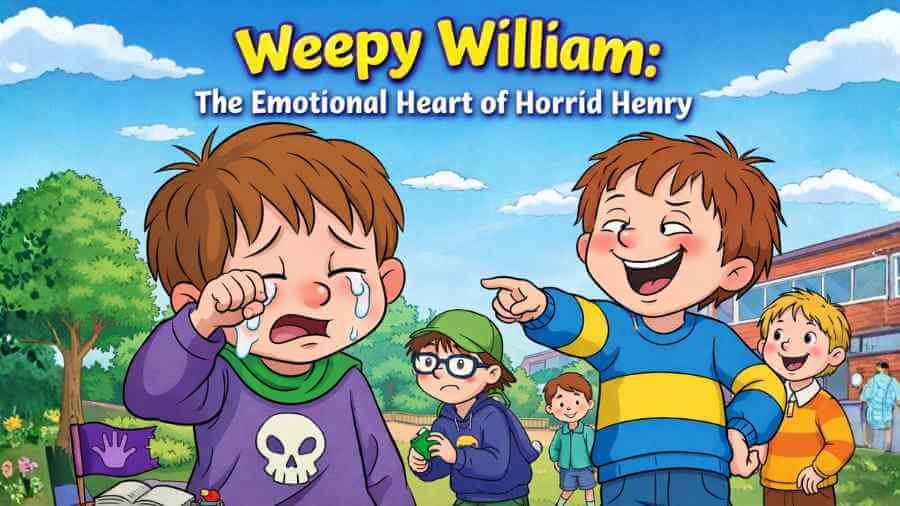
Weepy William is one of the most recognisable and quietly fascinating characters from the world of Horrid Henry. While the series is famous for loud antics, cheeky behaviour, and constant mischief, Weepy William stands apart as a symbol of sensitivity in a noisy, rule-breaking universe. His tears, often played for humour, actually give the character depth and relatability, especially for children who feel emotions strongly but struggle to express them confidently.
Who Is Weepy William?
Weepy William is a schoolmate of Horrid Henry and a recurring background character who occasionally steps into the spotlight. As his name suggests, he is known for crying easily, whether the situation is genuinely upsetting or only mildly uncomfortable. In a classroom filled with loud voices and dominant personalities, William’s emotional openness immediately makes him stand out.
He is not portrayed as unintelligent or weak. Instead, he is gentle, cautious, and emotionally expressive. These traits often put him at odds with the more aggressive or confident children around him, but they also make him one of the most human characters in the series.
Personality and Emotional Traits
At the core of Weepy William’s character is sensitivity. He feels things deeply and reacts honestly. Where others might hide fear or embarrassment, William shows it openly. His tears are not always sadness; sometimes they come from stress, surprise, fear, or even empathy.
This emotional transparency makes him relatable to many children who experience big feelings but lack the vocabulary to explain them. Rather than suppressing emotion, William expresses it fully, even when it leads to teasing or misunderstanding.
Key personality traits include:
High emotional awareness
Gentle and cautious behaviour
Strong sense of empathy
Shyness in social situations
Desire to follow rules and avoid conflict
These traits balance the chaos of Horrid Henry’s world and offer a different way of navigating childhood challenges.
Weepy William’s Role at School
In the school setting, Weepy William is often the child who worries about consequences. Tests, injections, reprimands from teachers, and peer pressure all affect him strongly. While other children may shrug off these moments, William internalises them.
Teachers sometimes view him as fragile, while classmates may see him as an easy target for jokes. Despite this, he continues to attend school, participate in activities, and try his best. This quiet resilience is one of his most overlooked strengths.
Rather than being a troublemaker, Weepy William represents the children who want to do well, follow the rules, and avoid trouble, even when the world around them feels overwhelming.
Relationship with Horrid Henry
The contrast between Weepy William and Horrid Henry is deliberate and effective. Henry is loud, confident, rebellious, and often dismissive of others’ feelings. William, on the other hand, is cautious, emotional, and deeply affected by his surroundings.
Their interactions usually highlight this contrast. Henry may mock or ignore William’s feelings, but these moments also underline Henry’s lack of empathy. In this way, Weepy William acts as a mirror, showing the emotional cost of Henry’s behaviour without needing a lecture or moral speech.
Interestingly, William’s presence does not exist solely to make Henry look bad. Instead, it enriches the story by presenting multiple emotional responses to the same situation.
The Purple Hand Gang Connection
Weepy William is often associated with the Purple Hand Gang, a group of children known for their nervous energy and rule-following tendencies. Within this group, William fits naturally. He is not the leader, but he contributes through loyalty and emotional awareness.
The gang provides him with a sense of belonging, which is important for a child who often feels overwhelmed. Being part of a group helps William cope with his fears, even if those fears never fully disappear.
This dynamic subtly reinforces the idea that emotional children still need friendship and community, not isolation or ridicule.
Humour and Misunderstanding
From a storytelling perspective, Weepy William is often used for comedic effect. His crying can be exaggerated, timed for laughs, or used as a punchline. However, the humour rarely feels cruel. Instead, it reflects the way children sometimes laugh at situations they do not fully understand.
For adult viewers, this humour can be bittersweet. It highlights how easily emotional expression is dismissed, especially in boys. William’s tears challenge traditional expectations of toughness and emotional restraint, even when the show plays them lightly.
Representation of Emotional Children
Weepy William is important because he represents a type of child rarely given centre stage. Emotional sensitivity is often treated as something to be corrected rather than accepted. William’s continued presence suggests that there is room for different emotional styles in childhood narratives.
He does not magically become fearless or emotionally detached. Instead, he remains himself throughout the series. This consistency sends a quiet but powerful message: it is acceptable to feel deeply, even in a world that values confidence and toughness.
Psychological Depth Beneath the Surface
Although designed for children, Weepy William’s character aligns closely with real psychological traits. Highly sensitive children often experience stronger reactions to stress, noise, and social pressure. They are not weaker; their nervous systems simply process information more intensely.
William’s tears can be seen as a coping mechanism rather than a flaw. Crying helps him release emotional tension and regain balance. From this perspective, his behaviour is healthy, even if misunderstood by peers.
This makes him an unintentionally educational character, helping children recognise and normalise emotional responses.
Audience Connection and Fan Appreciation
Over time, Weepy William has developed a loyal following. Many viewers, particularly those who felt emotionally overwhelmed as children, see themselves in him. Online discussions and fan interpretations often defend William, pointing out his kindness, honesty, and bravery in facing everyday fears.
His popularity proves that not all beloved characters need to be loud heroes or clever rebels. Sometimes, the quiet child who feels too much leaves the deepest impression.
Cultural Significance
In the context of British children’s television, Weepy William reflects a shift towards more emotionally diverse characters. Rather than presenting a single model of behaviour, the series allows multiple personalities to coexist, clash, and grow.
William’s presence subtly challenges outdated ideas about masculinity, strength, and emotional control. Without making a statement, he simply exists as he is, and that alone is meaningful.
Lessons Children Can Learn from Weepy William
Children watching Weepy William may learn several valuable lessons:
Emotions are natural and valid
Crying is not something to be ashamed of
Sensitivity can coexist with courage
Being different does not mean being wrong
These lessons are not delivered through speeches or moral endings. They are absorbed naturally through repeated exposure to William’s character.
Why Weepy William Still Matters Today
Even years after his introduction, Weepy William remains relevant. Modern conversations around mental health, emotional intelligence, and empathy make his character feel ahead of its time. He embodies traits that society is only now beginning to fully appreciate.
In a media landscape still dominated by confident, fearless protagonists, Weepy William offers an alternative narrative: one where vulnerability is visible and humanity is celebrated.
Conclusion
Weepy William is far more than a crying child used for comic relief. He is a thoughtful, emotionally rich character who brings balance, realism, and heart to the world of Horrid Henry. Through his sensitivity, he represents countless children who feel deeply and navigate the world with caution and empathy.
His continued popularity proves that audiences value authenticity, even in animated form. By allowing Weepy William to remain unapologetically himself, the series offers a quiet but powerful reminder that every emotional style deserves understanding and respect.