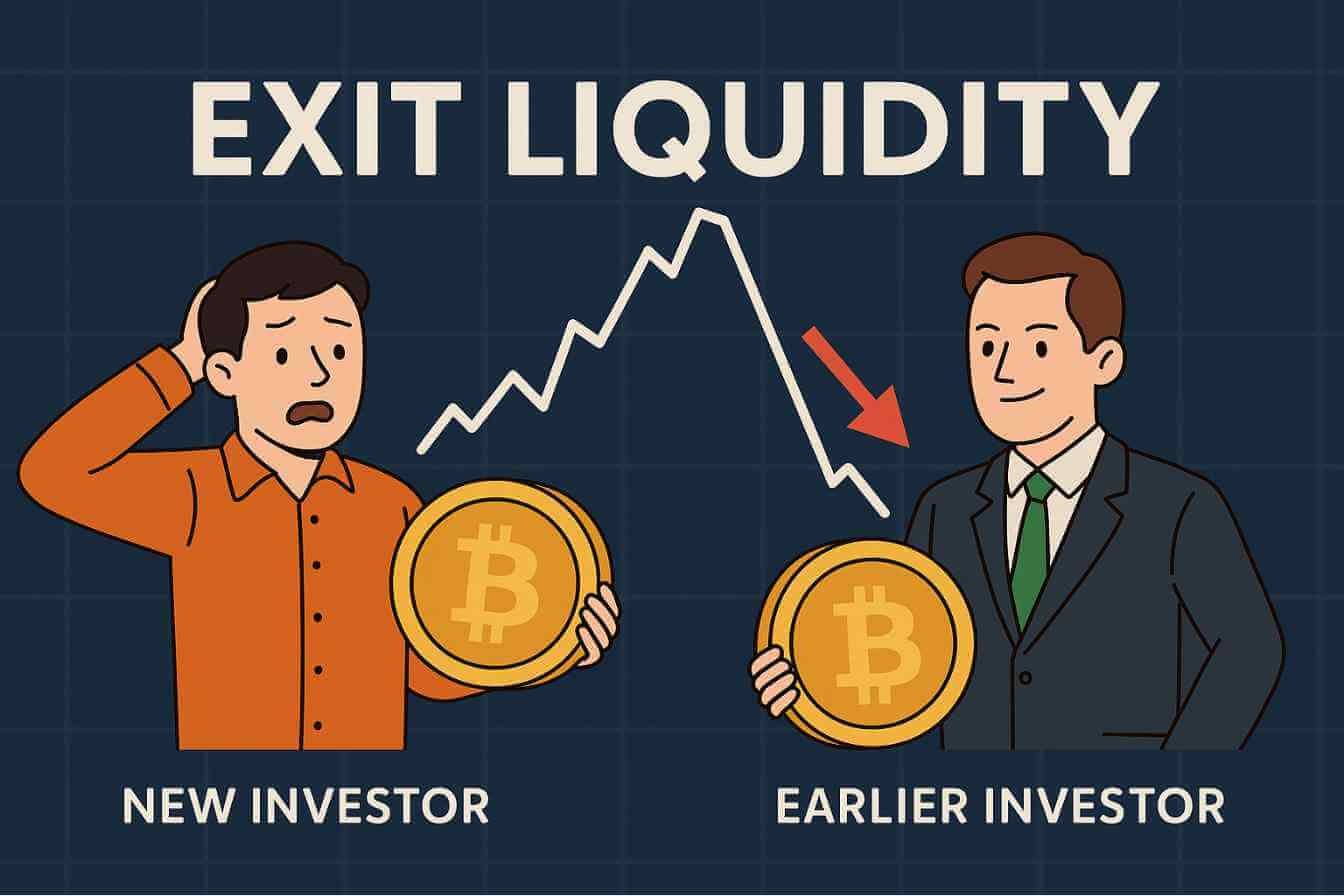
The term exit liquidity has become a defining phrase in the modern world of cryptocurrency and speculative trading. Though it sounds technical, the meaning is surprisingly simple: it refers to the buyers who unknowingly allow early investors or insiders to sell their holdings at a profit. In many cases, these late entrants purchase at inflated prices created by hype, misinformation, or artificial market manipulation, only to watch the price collapse afterwards. Becoming someone’s exit liquidity is one of the most common and costly mistakes made by new traders entering fast-moving markets without a proper understanding of liquidity, trading psychology, and price dynamics.
What Exit Liquidity Really Means
In the simplest terms, exit liquidity describes the last group of buyers who purchase an asset at a high price just before it collapses. These buyers unintentionally provide the liquidity needed for earlier investors to sell their positions. Once the early sellers successfully exit, the price drops sharply due to reduced demand, leaving late buyers facing substantial losses.
The phrase is widely used in cryptocurrency trading circles, where extreme volatility, thin liquidity, and hype-driven movements create ideal conditions for such situations. While exit liquidity can theoretically occur in any market, the combination of speculation and emotion in crypto makes it a far more common phenomenon.
The Psychology Behind Becoming Exit Liquidity
Human behaviour is a powerful force within financial markets. Most exit liquidity events are not purely technical; instead, they arise from emotions such as fear, greed, impatience, and the desire to catch rapid profits. Traders often fall into the trap because of:
Fear of Missing Out (FOMO)
When an asset begins rising quickly, many assume the trend will continue indefinitely. Social media posts, online excitement, and group discussions can fuel the fear of being left behind. This emotional rush causes traders to buy at the top, providing the perfect exit opportunity for earlier investors.
Greed During Parabolic Moves
When early profits appear easy, greed blinds many to the potential risks. Traders start imagining huge returns rather than considering whether the asset has reached exhaustion. This psychological state leads buyers to ignore warning signs such as unrealistic valuations or declining trading volume.
Overconfidence and Herd Mentality
Many believe the crowd cannot be wrong. If thousands are buying, they assume it must be safe. Unfortunately, herd behaviour often ends with a sharp reversal once the majority runs out of buying power. Early investors rely on this herd to serve as their exit liquidity.
Lack of Fundamental Knowledge
Many new traders do not understand market principles such as liquidity depth, order books, market cycles, and supply-and-demand equilibrium. Without this knowledge, they become vulnerable to manipulation and misleading signals.
How Exit Liquidity Works in Practice
Exit liquidity events typically follow a predictable pattern:
1. Early Accumulation
A small group of insiders or early investors buys an asset when it is still unnoticed. The prices are low, and liquidity is thin.
2. Price Manipulation or Organic Hype
The asset begins to rise. This can occur naturally due to genuine interest or artificially through coordinated effort, aggressive marketing, or misleading campaigns. As the price increases, traders take notice.
3. Public Hype and Rapid Inflows
The asset suddenly explodes on social media platforms, discussion forums, or trading groups. New traders rush in, driven by excitement. This period is where most of the exit liquidity is created.
4. Early Investors Sell
The insiders or earliest holders begin unloading their positions quietly. They take profits while buyers continue entering, unaware they are catching the market at its peak.
5. Sharp Collapse
Demand dries up. Without new buyers, the price cannot sustain its inflated level. It then drops rapidly, sometimes losing more than half its value within minutes.
6. Retail Traders Left Holding Losses
The newest investors buy at the very top and become the exit liquidity that funded the profits for the early sellers. They are left with large losses that can take years to recover, if ever.
Why Crypto Markets Are Especially Vulnerable
While exit liquidity exists in stocks, commodities, and other markets, cryptocurrency markets experience it more often due to several unique characteristics.
Low Liquidity Assets
Many cryptocurrencies, especially small or newly launched tokens, have very limited liquidity. This means that even moderate buying or selling pressure can dramatically move the price.
Lack of Regulation
Traditional markets have regulations to prevent manipulation. Crypto markets, in contrast, remain largely decentralised and unregulated. This opens the door for pump-and-dump schemes, insider trades, and coordinated manipulation.
Influence of Social Media
A single influencer, viral post, or trending hashtag can create massive hype within minutes. The speed at which information spreads dramatically increases the risk of emotional buying followed by sharp declines.
Meme Coins and Speculative Tokens
Many tokens have no real value, utility, or long-term plan. They exist purely for speculation. These tokens rely heavily on hype, making them perfect environments for exit liquidity traps.
Anonymous Developers
Some crypto projects are created by individuals who remain anonymous. They can disappear, dump their tokens, or abandon the project entirely, leaving investors with worthless assets.
Signs You Are About to Become Exit Liquidity
Investors can protect themselves by recognising early warning signs such as:
- Sudden price spikes without real news or development updates
- Extremely low trading volume followed by sudden hype
- Influencers promoting a coin aggressively without clear reasoning
- Unrealistic promises made by a project or its developers
- Anonymous founders with no proven track record
- Tokens listed on small exchanges with limited order book depth
- Large holders owning a disproportionate share of the supply
If several of these warning signs appear together, the risk of becoming exit liquidity increases significantly.
How to Avoid Becoming Exit Liquidity
Avoiding the trap requires discipline, research, and emotional control. The following strategies are essential:
1. Study the Fundamentals
Before buying any asset, understand what it does, who created it, and why it has value. A lack of fundamentals is one of the strongest indicators of a potential exit liquidity scenario.
2. Check Liquidity and Trading Volume
Always examine how much liquidity is available. If you cannot sell quickly without drastically affecting the price, you are at immediate risk.
3. Analyse Past Price Movements
If an asset has pumped rapidly with little explanation, it may already be near its peak. Learning to interpret charts and patterns helps reduce emotional decision-making.
4. Avoid Blindly Following Influencers
Many influencers are paid to promote tokens. Their followers, unaware of the arrangement, become exit liquidity once the influencer sells.
5. Do Not Chase Hype
If everyone is talking about a coin, chances are the easy gains are already gone. Buying during peak excitement nearly always results in losses.
6. Take Profits Strategically
Rather than waiting for unrealistic highs, disciplined profit-taking helps prevent being trapped during reversals.
The Consequences of Providing Exit Liquidity
Becoming exit liquidity can have long-term effects on a trader’s confidence, financial stability, and willingness to continue participating in markets. Many leave cryptocurrency entirely after experiencing significant losses, often blaming the market rather than recognising the psychological traps they fell into.
Understanding liquidity, risk, and market cycles is essential for long-term success. Those who learn from their mistakes often return stronger, more knowledgeable, and better equipped to recognise dangerous situations.
Conclusion
Exit liquidity is not just a technical concept; it is a psychological and behavioural phenomenon that shapes the movements of speculative markets, especially cryptocurrency. It occurs when late buyers unknowingly allow earlier investors to exit profitably at inflated prices, often driven by hype, manipulation, or panic.
By understanding how exit liquidity works, identifying red flags, and adopting disciplined trading habits, investors can drastically reduce their chances of being caught in these traps. Knowledge, patience, and emotional control are the strongest tools in avoiding becoming someone else’s exit strategy.