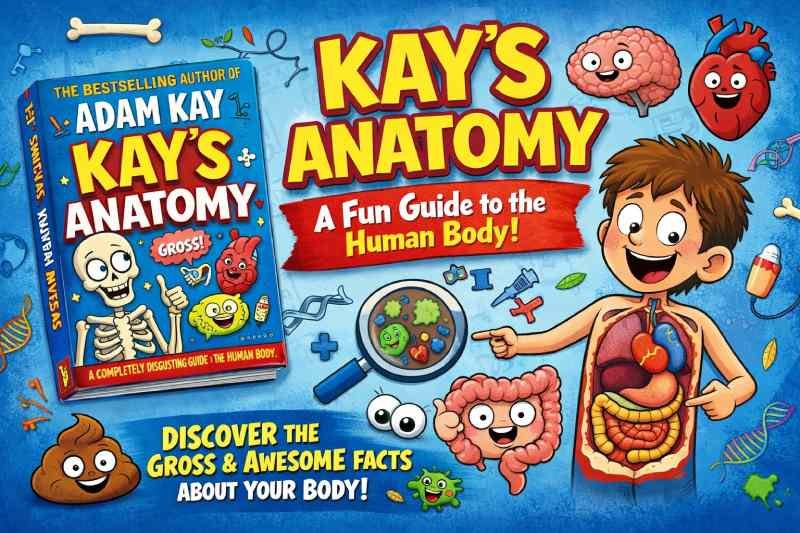
In the crowded world of children’s science books, Kays Anatomy stands out as a refreshingly funny, brilliantly informative, and surprisingly accurate introduction to the human body. Written by former doctor and bestselling author Adam Kay, the book manages to achieve something rare: it makes complex biology genuinely entertaining for young readers while still delivering real educational value.
What Is Kays Anatomy?
At its core, Kays Anatomy is a children’s non-fiction book that explains how the human body works in a humorous, accessible way. Unlike traditional textbooks, it avoids dry academic language and instead uses jokes, cartoons, quirky facts, and relatable examples.
The book was written by Adam Kay, a former NHS doctor best known for his witty medical memoirs. Drawing on his medical background and comedic style, he created Kays Anatomy to make science less intimidating and more engaging for younger audiences.
Target Age Group
The book is primarily aimed at:
- Children aged 9–12
- Key Stage 2 and early Key Stage 3 pupils
- Reluctant readers who enjoy humour
- Families looking for educational but fun reading
However, many adults in the UK admit they learned a thing or two while reading Kays Anatomy with their children.
Why Kays Anatomy Became So Popular in the UK
The success of Kays Anatomy did not happen by accident. Several factors contributed to its strong reception among British readers.
A Perfect Balance of Funny and Educational
One of the biggest strengths of Kays Anatomy is its tone. Many children’s science books are either:
- Too serious and textbook-like, or
- Too silly to be genuinely educational
Adam Kay manages to strike the perfect middle ground. The humour keeps readers turning pages, while the factual content ensures the book still supports learning.
Written by a Real Doctor
Credibility matters, especially when explaining the human body. Because the author is a former NHS doctor, parents and teachers feel confident that Kays Anatomy is medically sound despite its playful style.
This professional background gives the book authority without making it intimidating.
Appealing Visual Style
The illustrations play a major role in the book’s success. They are:
- Colourful and eye-catching
- Slightly gross in a child-friendly way
- Easy to understand
- Perfect for visual learners
These visuals help Kays Anatomy compete with screen-based entertainment by keeping young readers engaged.
Key Topics Covered in the Book
Although it feels light-hearted, Kays Anatomy covers a surprisingly wide range of biological topics. The book introduces children to the major systems of the human body in a structured but entertaining way.
The Skeleton and Bones
Readers learn:
- How many bones are in the human body
- Why bones are strong but lightweight
- How fractures heal
- Fun facts about unusual bones
The explanations are simplified without being misleading, making Kays Anatomy suitable for school support.
The Brain and Nervous System
This section explains:
- How the brain controls the body
- Why we need sleep
- How nerves send messages
- What happens when we feel pain
Complex neuroscience concepts are broken down into language children can grasp easily.
The Heart and Circulation
One of the most engaging chapters in Kays Anatomy focuses on the cardiovascular system. It covers:
- How the heart pumps blood
- What blood actually does
- Why exercise affects heart rate
- Interesting facts about heart size and speed
The combination of humour and real science helps this topic stick in young readers’ minds.
The Digestive System
Children are naturally fascinated by digestion, and Kays Anatomy leans into this curiosity.
Topics include:
- What happens to food after swallowing
- The role of the stomach and intestines
- Why burps and farts happen
- How nutrients reach the body
The slightly gross humour is exactly what makes this section memorable.
Puberty and Body Changes
Importantly, the book also touches on growing up. Kays Anatomy handles puberty in a sensitive, age-appropriate way, helping children understand:
- Why bodies change
- What to expect during growth
- Basic hygiene and development
For many UK families, this makes the book a useful conversation starter.
Educational Value in UK Classrooms
Teachers across the UK have found Kays Anatomy particularly useful as a supplementary science resource. While it is not a formal textbook, it supports curriculum learning in several ways.
Supporting Key Stage Science
The content aligns well with topics taught in:
- Key Stage 2 science
- Early Key Stage 3 biology
- Basic human body units
Teachers often use passages from Kays Anatomy to introduce topics before moving into more formal materials.
Encouraging Reluctant Readers
One of the biggest classroom benefits is engagement. Many pupils who avoid traditional non-fiction are happy to pick up Kays Anatomy because it feels entertaining rather than academic.
This makes it especially valuable for:
- Lower-confidence readers
- Pupils who prefer humorous books
- Children who struggle with dense textbooks
Promoting Scientific Curiosity
Because the book answers questions children actually wonder about, Kays Anatomy helps spark curiosity. Instead of memorising facts, readers begin asking their own “why does the body do that?” questions.
This inquiry-based interest is exactly what good science education aims to develop.
Strengths That Set Kays Anatomy Apart
While many anatomy books exist for children, several features help this one stand out in the UK market.
Highly Accessible Language
The writing style is conversational and clear. Medical terms are introduced but always explained in plain English. This ensures Kays Anatomy remains approachable without oversimplifying.
Humour That Actually Works
Children’s humour can sometimes feel forced. Here, the jokes feel natural and well-timed. The comedic tone supports learning rather than distracting from it.
Strong Parent Appeal
Parents appreciate that Kays Anatomy is:
- Educational
- Medically accurate
- Age-appropriate
- Engaging enough to compete with screens
This combination has helped drive strong word-of-mouth recommendations across the UK.
Cross-Generational Enjoyment
Interestingly, many adults report enjoying the book themselves. The writing includes subtle wit that older readers can appreciate, making Kays Anatomy a genuinely family-friendly read.
Any Limitations to Be Aware Of
No book is perfect, and it is worth noting a few limitations.
Not a Replacement for Textbooks
While informative, Kays Anatomy is designed as a popular science book rather than a full curriculum textbook. Students needing detailed exam preparation will still require more formal resources.
Humour May Not Suit Every Child
Although most children love the slightly gross jokes, a small minority may prefer a more serious tone. Parents know their children best when deciding if Kays Anatomy is the right fit.
Depth Is Introductory
The explanations are intentionally simplified. This is ideal for younger readers but means advanced learners may outgrow the material over time.
Who Should Buy Kays Anatomy?
This book is especially well suited for:
- Parents of curious children aged 9–12
- UK primary school teachers
- Home educators
- Gift buyers looking for educational books
- Children interested in the human body
If your goal is to make science enjoyable rather than intimidating, Kays Anatomy is a strong candidate.
FAQs
Is Kays Anatomy suitable for UK school children?
Yes, it is widely considered appropriate for Key Stage 2 and early Key Stage 3 pupils. Many UK teachers use it as a supplementary learning resource.
Who wrote Kays Anatomy?
The book was written by Adam Kay, a former NHS doctor and bestselling British author known for making medical topics accessible and funny.
Is Kays Anatomy medically accurate?
Despite its humorous tone, the book is generally regarded as scientifically reliable for its target age group. It simplifies concepts but does not intentionally mislead.
What age is best for reading Kays Anatomy?
Most readers between 9 and 12 years old will get the most benefit, although younger advanced readers and older reluctant readers may also enjoy it.
Can adults learn from Kays Anatomy?
Absolutely. Many parents report picking up new facts while reading alongside their children, which adds to the book’s broad appeal.
Conclusion
Kays Anatomy succeeds because it understands something many educational books forget: children learn best when they are genuinely interested. By blending real medical knowledge with humour, engaging illustrations, and clear explanations, Adam Kay has created a resource that entertains while it educates.