Platts Eyot is one of those rare places in England that quietly holds centuries of history while remaining largely unknown to the wider public. Resting in the River Thames near Hampton, this small island has played an outsized role in British industrial, maritime, and cultural heritage. Though modest in size, Platts Eyot has witnessed transformations that reflect the wider story of Britain itself, from rural river life to industrial innovation and modern creative reuse.
What and Where Is Platts Eyot?
Platts Eyot is a river island, traditionally known as an “eyot” or “ait,” a term historically used along the Thames to describe small islands formed by river sediment. The island lies close to Hampton, within the London Borough of Richmond upon Thames, positioned between key lock sections of the river.
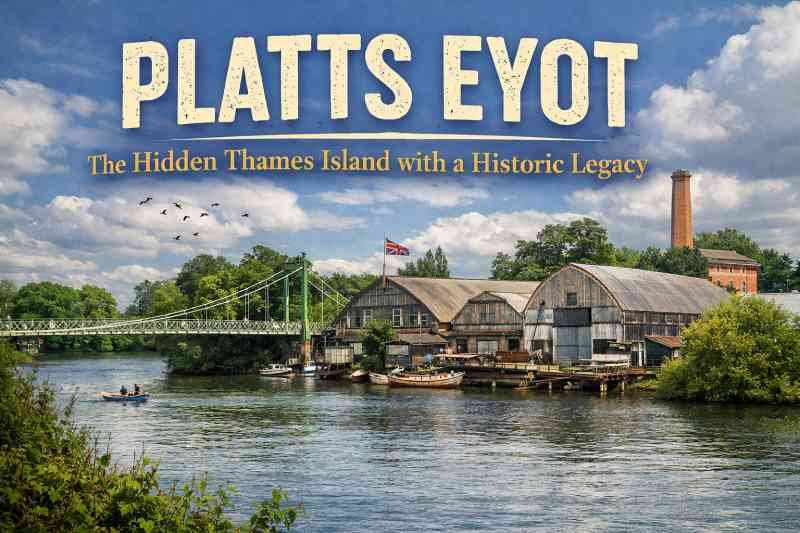
Access to the island is limited, which has helped preserve its distinctive character. A narrow pedestrian suspension bridge links it to the mainland, reinforcing the sense that stepping onto Platts Eyot is like stepping back into another time. The surrounding waters, tree-lined banks, and historic structures give the island a quiet, almost secluded charm despite its proximity to London.
Early Origins and Natural Landscape
Long before it became known for boatbuilding, Platts Eyot was shaped primarily by nature. Originally, it consisted of low-lying land used for growing osiers, or willow trees, which were harvested for basket-making and other rural crafts. This kind of activity was common along the Thames, where river islands provided ideal conditions for fast-growing willow.
Over time, the island’s landscape changed as soil and materials from nearby engineering works were deposited there. These changes subtly altered the island’s profile, creating higher ground in places and allowing for more permanent structures to be built. Despite these modifications, Platts Eyot has retained a strong connection to its natural surroundings, remaining part of an ecologically significant stretch of the Thames.
The Rise of Boatbuilding on the Island
The defining chapter in the history of Platts Eyot began in the late nineteenth century with the arrival of organised boatbuilding. This development transformed the island from a quiet riverside space into a hub of skilled craftsmanship and industrial activity.
Boatbuilders were drawn to the island because of its direct river access and relative isolation. Workshops and sheds were constructed to house the tools, timber, and vessels required for both leisure and professional boating. These early enterprises laid the foundation for what would become one of the most important inland boatbuilding sites in Britain.
Innovation and National Importance
During the early twentieth century, Platts Eyot gained national significance through its association with advanced boat design and engineering. The island became known for producing fast, reliable craft at a time when naval technology was rapidly evolving. Skilled workers combined traditional woodworking techniques with modern engineering principles, resulting in vessels that were admired both domestically and internationally.
This period marked the island’s transition from a local industry site to a nationally important centre of innovation. Boats constructed on Platts Eyot were not only used for leisure but also adapted for more demanding purposes, reflecting Britain’s growing maritime ambitions.
Platts Eyot During the World Wars
The strategic importance of Platts Eyot became particularly evident during the First and Second World Wars. As demand increased for military vessels, the island’s workshops played a role in producing fast launches and specialised boats designed for wartime conditions.
Workers on the island contributed directly to the national effort, often under intense pressure and tight deadlines. This wartime production added a layer of historical significance to Platts Eyot, linking it to moments of national challenge and resilience. The craftsmanship developed during this era remains a point of pride in the island’s story.
Architectural Character and Historic Structures
One of the most striking features of Platts Eyot is its industrial architecture. The boat sheds, many of which were built using distinctive truss designs, reflect the practical needs of large-scale boat construction. These structures were designed to accommodate long hulls, heavy materials, and complex assembly processes.
Over time, these buildings gained recognition not just for their function but for their architectural and historical value. They stand as rare examples of inland industrial boatbuilding architecture, offering insight into a craft that once flourished along the Thames.
Transition and Decline of Traditional Industry
Like many traditional industrial sites, Platts Eyot faced challenges in the post-war period. Changes in manufacturing methods, economic pressures, and shifts in transport reduced the demand for small-scale inland boatbuilding. Gradually, workshops closed or were repurposed, and the island entered a period of transition.
However, this decline did not mean abandonment. Instead, it opened the door to new uses that respected the island’s heritage while allowing it to evolve. The challenge became how to preserve the historical character of Platts Eyot while ensuring it remained relevant in a modern context.
Creative Reuse and Modern Identity
In recent decades, Platts Eyot has found new life through creative and small-scale commercial activities. Some of the old industrial buildings have been adapted for studios, workshops, and specialist uses that value privacy and atmosphere.
This adaptive reuse has helped maintain the island’s working character without erasing its past. Rather than becoming a static museum, Platts Eyot continues to function as a living place where history and contemporary creativity coexist. This balance is one of the reasons the island remains so compelling.
Environmental and Conservation Significance
Beyond its industrial heritage, Platts Eyot holds ecological importance. The surrounding river environment supports a variety of plant and animal life, and the island itself forms part of a wider conservation landscape along the Thames.
Careful management has been essential to protect this environment while accommodating human activity. Conservation policies recognise the island’s dual value as both a historic industrial site and a natural riverside habitat, ensuring that any future development respects these qualities.
Cultural Impact and Public Fascination
Platts Eyot has captured public imagination in subtle ways. Its secluded nature, combined with its layered history, has made it the subject of local stories, artistic interest, and heritage discussions. Though not a conventional tourist attraction, it holds a special place in the cultural memory of the area.
For many, the island represents a quieter, more reflective side of British history, one that values craftsmanship, resilience, and continuity over spectacle.
Why Platts Eyot Still Matters Today
In an age of rapid development and constant change, Platts Eyot offers an alternative narrative. It demonstrates how places can evolve without losing their identity, adapting to new uses while honouring their past.
The island’s story highlights the importance of preserving industrial heritage, not as relics frozen in time, but as living environments that continue to serve communities in new ways. Platts Eyot stands as a reminder that history does not always need grand monuments to remain meaningful.
Conclusion
Platts Eyot is far more than a small island in the Thames. It is a place where nature, industry, and history intersect in a uniquely British way. From its early days as a willow-growing eyot to its rise as a centre of boatbuilding excellence, the island has continually adapted while retaining its essential character.
Today, Platts Eyot serves as a quiet but powerful example of how heritage can be preserved through thoughtful reuse and respect for the past. Its story reminds us that even the smallest places can leave a lasting imprint on national history, provided they are allowed to evolve with care and purpose.
FAQs
What makes Platts Eyot different from other Thames islands?
Platts Eyot stands out due to its strong association with inland boatbuilding and industrial innovation, rather than purely residential or natural use.
Can the public freely visit Platts Eyot?
Access is limited, and much of the island is privately used, which helps preserve its character and historic structures.
Is Platts Eyot protected for heritage reasons?
Yes, the island is recognised for its historical and architectural significance, with conservation measures in place to protect key features.
Does Platts Eyot still have working buildings today?
Some buildings are still in use for specialised purposes, reflecting the island’s continued role as a working environment.
Why is Platts Eyot important to British history?
Its contribution to boatbuilding, especially during key industrial and wartime periods, gives it lasting national significance.