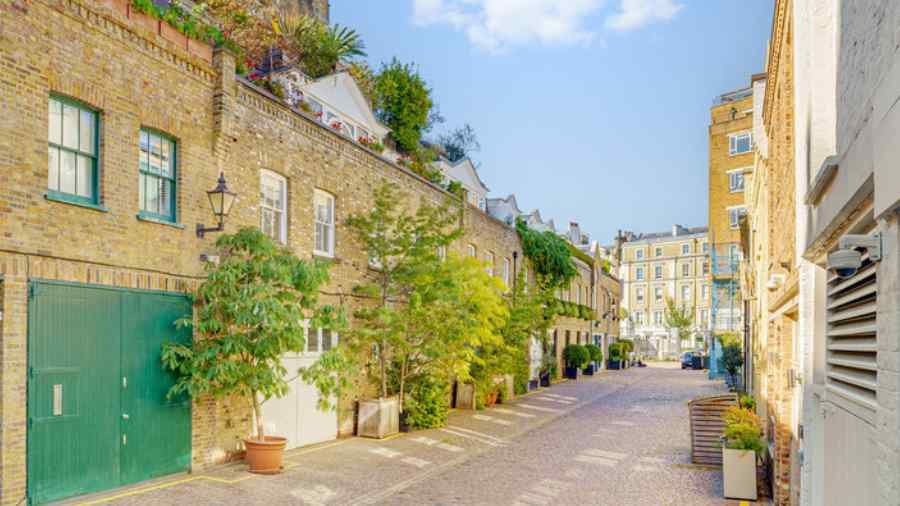
Nestled quietly within the heart of South Kensington lies Reece Mews, one of London’s most captivating and culturally significant streets. Though modest in appearance, this cobbled mews has witnessed a remarkable transformation through time—from humble service quarters to a prestigious residential haven. Yet, beyond its architectural charm and prime location, Reece Mews holds a far greater legacy: it was the creative sanctuary of one of the twentieth century’s greatest painters, Francis Bacon. His presence turned this unassuming street into a symbol of artistic genius, resilience, and the spirit of post-war London.
The Historical Origins of Reece Mews
The story of Reece Mews dates back to the nineteenth century when mews streets were a quintessential feature of London’s urban design. These narrow lanes, usually located behind grand terraced houses, served as stable yards where horses and carriages were kept. Servants and coachmen lived above the stables, providing discreet access to the service quarters without disturbing the main residences.
In the South Kensington district, Reece Mews was built to serve the elegant houses along Queen’s Gate and Old Brompton Road. It represented a practical yet beautifully structured environment—a world hidden behind the glamour of London’s upper-class lifestyle. As time passed and motor vehicles replaced horses, the need for stables diminished. Slowly, these spaces evolved into desirable residential dwellings.
By the mid-twentieth century, Reece Mews, like many others in Kensington, began attracting artists, writers, and professionals seeking privacy and inspiration within the city. Its cobbled paths, intimate proportions, and tucked-away charm offered the ideal creative retreat, and none embraced it more profoundly than Francis Bacon.
Francis Bacon and 7 Reece Mews
Among the rows of discreet homes along the street, 7 Reece Mews achieved global fame for being the long-time studio of Francis Bacon, the Irish-born British painter renowned for his emotionally raw and expressive works. Bacon discovered this modest mews house in 1961 and immediately recognised its potential as a personal and creative refuge.
The studio itself was small, cluttered, and chaotic—a perfect reflection of Bacon’s artistic temperament. Paint tubes, brushes, torn photographs, and fragments of drawings littered the floor. The walls were thickly layered with years of pigment, testifying to endless experimentation. Yet, in the midst of this disorder, Bacon produced some of his most iconic works, including the haunting “Triptych” series and portraits of his close friends and lovers.
For Bacon, 7 Reece Mews was not just a studio; it was his world. He lived, worked, and entertained guests there, rarely separating his personal life from his creative process. The confined space mirrored his intense and isolated nature. Despite the success and fame he attained, he remained loyal to this humble workspace until his death in 1992.
After his passing, the studio became the subject of meticulous preservation. In an extraordinary project, every item within the studio—more than 7,000 objects—was carefully catalogued, removed, and reconstructed at the Hugh Lane Gallery in Dublin, where it remains on permanent display. Yet the spirit of the original space still lingers within Reece Mews, immortalising Bacon’s genius in its walls.
Architectural Character and Design
Architecturally, Reece Mews is a quintessential example of London’s preserved mews heritage. The street is paved with traditional cobblestones, flanked by low-rise houses that retain their nineteenth-century facades. Most buildings consist of two storeys, featuring arched garage openings on the ground floor and modest windows above.
While many mews across London have undergone modernisation, Reece Mews maintains a sense of authenticity. Some houses have been sympathetically refurbished with subtle extensions, roof conversions, and updated interiors, but the street’s visual unity remains intact. The balance between old-world charm and contemporary sophistication gives it a unique aesthetic appeal.
The exterior simplicity conceals luxurious interiors. Many current properties feature high-end finishes, open-plan living spaces, and private terraces, making them among the most sought-after addresses in South Kensington. Yet, despite its wealth, the street continues to project an understated grace, avoiding the ostentation seen elsewhere in central London.
The Evolution of Reece Mews
Over the decades, Reece Mews has evolved from a hidden service street to a coveted residential enclave. Its location within the Royal Borough of Kensington and Chelsea has undoubtedly contributed to its desirability. Positioned between Old Brompton Road and Harrington Road, it offers immediate access to world-renowned landmarks such as the Victoria and Albert Museum, the Natural History Museum, and Hyde Park.
In the post-war years, as London’s art and cultural scene blossomed, many artists and intellectuals sought quiet urban retreats. The mews, with its secluded charm, became ideal for creative minds. While Francis Bacon remains the most famous resident, Reece Mews has continued to attract an eclectic mix of owners—architects, designers, and professionals drawn by its history and character.
In recent decades, property values have soared. Houses on Reece Mews now command multi-million-pound prices, reflecting both their rarity and prestige. Yet, for those who stroll down the cobbled lane, the atmosphere of quiet privacy remains remarkably unchanged, a testament to London’s ability to preserve its historic soul amidst modern development.
The Artistic and Cultural Legacy
Reece Mews is not merely an address; it is a cultural landmark. The connection to Francis Bacon has elevated its status to near-mythical proportions in the art world. His creative energy transformed the street into a place of pilgrimage for art historians, collectors, and admirers of modern expressionism.
Bacon’s studio represents more than the physical space in which he worked—it embodies the paradox of chaos and discipline that defined his art. From the confined environment of 7 Reece Mews emerged paintings that explored the human condition, fear, beauty, and despair. The cramped walls witnessed an artist’s lifelong dialogue with mortality and emotion.
Even after the physical contents of the studio were relocated to Dublin, the address remains symbolic. For many, it stands as proof that true creativity does not require grandeur, but authenticity and dedication. In that sense, Reece Mews has transcended geography—it exists as a metaphor for artistic integrity within modern London.
Reece Mews in Modern London
Today, Reece Mews continues to charm both residents and visitors. It is a private road, maintaining its quiet dignity amidst the bustle of South Kensington. Tourists occasionally wander by, drawn by curiosity about Bacon’s legacy, while long-time residents enjoy the serenity that few other streets in central London can offer.
Real estate experts consider it one of the finest examples of preserved mews architecture in the capital. Each house, though similar in façade, tells a different story. Some properties retain vintage garage doors and wrought-iron balconies, while others embrace sleek minimalism. The variety of design within a shared historical framework adds to its character.
At dusk, the soft amber glow of streetlights falling on the cobbles creates an almost cinematic beauty. One can easily imagine Bacon walking home after an evening at the Colony Room Club, lost in thought, his mind alive with imagery and ideas. That emotional presence lingers even now, half a century later.
Why Reece Mews Still Matters
Reece Mews remains an emblem of London’s ability to preserve history while adapting to modern life. It encapsulates the city’s charm—the juxtaposition of old and new, luxury and humility, fame and anonymity. The street’s enduring appeal lies in its ability to transport visitors into another era while remaining firmly relevant in the present.
From a real estate perspective, Reece Mews exemplifies the value of cultural heritage in urban living. Its association with Francis Bacon has given it a unique identity that cannot be replicated by modern developments. Each brick carries the weight of artistic history, making ownership of a property there a privilege that extends beyond material wealth.
From an artistic viewpoint, it stands as a reminder that greatness often emerges from the simplest environments. Bacon’s work, forged within those modest walls, continues to inspire generations of artists. His creative legacy ensures that Reece Mews will forever occupy a special place in London’s cultural landscape.
Conclusion
Reece Mews may appear to be just another quiet street in South Kensington, but its story runs deep through the veins of London’s artistic and architectural heritage. From its origins as a functional stable lane to its rebirth as a cradle of modern art, it reflects the city’s evolution, resilience, and soul.
The legacy of Francis Bacon endows it with a timeless aura—a place where creativity triumphed over chaos and where history continues to breathe through every cobblestone. Today, Reece Mews stands not just as a location on a map, but as a living testament to London’s capacity to nurture art, preserve beauty, and celebrate the ordinary spaces that become extraordinary through human genius.