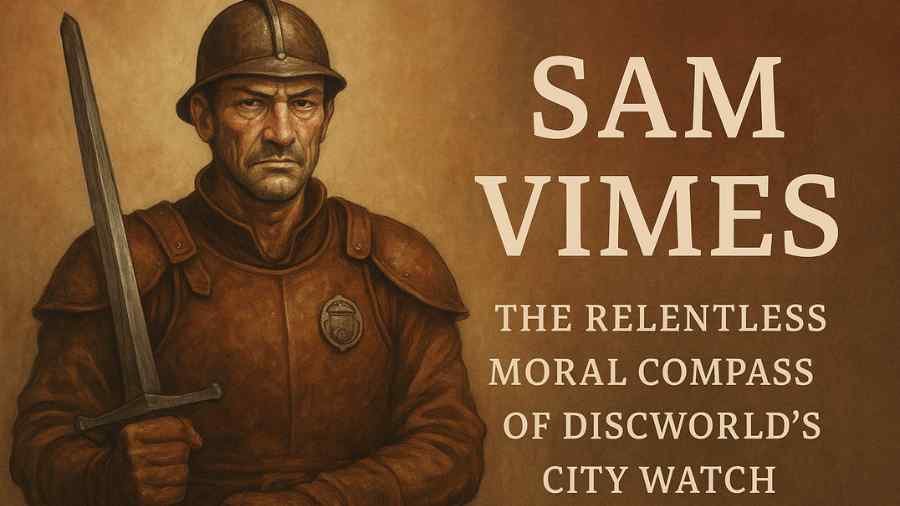
Sam Vimes stands as one of the most compelling and enduring characters in modern fantasy literature. Created by the late Sir Terry Pratchett, Sam Vimes is far more than a fictional policeman in a comic fantasy setting. He represents conscience, integrity, and the daily struggle to do what is right in a world that constantly tempts people to do otherwise. Through humour, grit, and sharp social observation, the character of Sam Vimes has become a symbol of justice grounded in humanity rather than authority.
The Origins of Sam Vimes
Sam Vimes was born and raised in the Shades, one of the poorest and most dangerous districts of Ankh-Morpork. His upbringing in grinding poverty shaped his worldview early, instilling in him a deep understanding of injustice and an instinctive distrust of power. Unlike characters who grow up shielded by wealth or privilege, Vimes learned quickly that laws often serve those who write them rather than those who suffer under them.
Before the events that define his career, Vimes is introduced as a man who has largely given up. At the beginning of his story, he is captain of a nearly defunct City Watch, a forgotten institution in a city where crime is effectively legalised through guilds. He drinks heavily, sleeps poorly, and expects little from the world or himself. Yet even in this broken state, there remains a stubborn core of decency that refuses to disappear.
A Man Shaped by the Streets
What sets Sam Vimes apart from many fictional law enforcers is his intimate relationship with the streets he patrols. He knows Ankh-Morpork not as a concept but as a living organism, with smells, sounds, and rhythms ingrained into his senses. His famous habit of walking the city at night reflects this connection. For Vimes, understanding a city means feeling it under his boots.
This grounding in reality makes him deeply sceptical of abstract ideals when they are divorced from lived experience. He does not believe crime can be solved through slogans or grand speeches. He believes in work, persistence, and being present. Justice, to Vimes, is not a shining principle but a daily effort that must be renewed every morning.
The Moral Code of Sam Vimes
At the heart of Sam Vimes lies one of the strongest moral frameworks in fantasy fiction. His sense of right and wrong is absolute, yet never simplistic. Vimes does not see the world in neat categories of good people and bad people. Instead, he recognises that everyone carries the potential for cruelty, including himself.
A defining element of his character is his awareness of what he calls “the beast” inside him. This inner darkness represents rage, prejudice, and the temptation to abuse power. Unlike characters who deny their flaws, Vimes confronts his own capacity for wrongdoing every day. His rigid adherence to the law is not blind obedience but a safeguard against becoming the kind of man he despises.
This internal struggle gives his morality weight. He does not do the right thing because it is easy or rewarding, but because failing to do so would mean losing himself.
Leadership and the City Watch
As Sam Vimes rises through the ranks to become Commander of the Ankh-Morpork City Watch, his approach to leadership reflects his values. He builds a force that represents the city in all its diversity, welcoming dwarfs, trolls, werewolves, and other marginalised groups. This inclusion is not driven by ideology but by practicality and fairness. A city is safer, Vimes believes, when everyone has a stake in protecting it.
Vimes leads by example rather than charisma. He expects discipline, honesty, and effort, but he also understands the limits of human weakness. His officers are not heroes in shining armour; they are ordinary people trying to do a difficult job. By trusting them with responsibility, he allows them to grow into it.
His transformation of the Watch mirrors his own personal growth. What was once a joke becomes a professional institution respected across Discworld, largely because Vimes insists that the badge means something.
Wealth, Power, and Reluctant Nobility
One of the great ironies of Sam Vimes’s life is his elevation into wealth and nobility. Through marriage and political necessity, he becomes a duke, gaining access to privilege he has always despised. Rather than softening him, this transition sharpens his anger at inequality.
Vimes never forgets what it means to be poor. He continues to wear old boots, mistrust lavish displays, and question the motives of the powerful. His wealth becomes a tool rather than a comfort, used to support institutions and protect others rather than elevate himself.
This tension between status and identity adds depth to his character. Vimes embodies the idea that power does not have to corrupt, but it will test anyone who holds it.
Sam Vimes as Social Commentary
Through Sam Vimes, Terry Pratchett delivers some of his most incisive social commentary. Policing, class systems, nationalism, and institutional hypocrisy are all examined through Vimes’s weary eyes. His scepticism toward authority reflects a broader critique of systems that claim moral superiority while failing the vulnerable.
Vimes’s views on crime are particularly striking. He understands that theft and violence often stem from desperation rather than malice. While he enforces the law without compromise, he never loses sight of the human stories behind each offence. This balance between compassion and accountability makes him a uniquely realistic figure.
The character also challenges romantic notions of heroism. Vimes is not glamorous. He is tired, angry, and often deeply unhappy. Yet he persists, suggesting that true heroism lies in endurance rather than triumph.
Key Relationships and Personal Life
Although Sam Vimes is often portrayed as solitary, his relationships play a crucial role in his development. His marriage introduces emotional stability and forces him to confront parts of himself he would rather ignore. Becoming a father further deepens his sense of responsibility, giving him a personal stake in the future he is trying to protect.
His relationships with fellow officers reveal his capacity for loyalty and trust. While he struggles with emotional expression, his actions consistently demonstrate care and respect. These connections ground him, preventing his cynicism from becoming bitterness.
Why Sam Vimes Endures
The enduring popularity of Sam Vimes lies in his honesty. He does not promise easy solutions or moral purity. Instead, he represents the daily effort to be decent in an indecent world. Readers recognise his flaws, his anger, and his exhaustion because they mirror real human experiences.
In a genre often dominated by chosen heroes and epic destinies, Vimes stands out as someone who chooses responsibility over glory. His victories are small, hard-won, and often invisible, yet they matter deeply.
Sam Vimes reminds readers that systems only improve when individuals refuse to look away, even when doing so would be more comfortable.
Conclusion
Sam Vimes is far more than a fictional police commander in a fantasy city. He is a study in moral endurance, a reflection of societal flaws, and a reminder that justice begins with personal accountability. Through his uncompromising integrity, deep self-awareness, and refusal to surrender to cynicism, Sam Vimes has secured his place as one of the most meaningful characters in modern literature.
His legacy endures because he speaks to a universal truth: doing the right thing is rarely easy, often thankless, but always necessary. In a world that constantly tests ethical boundaries, Sam Vimes stands as a stubborn, boot-worn reminder that conscience still matters.