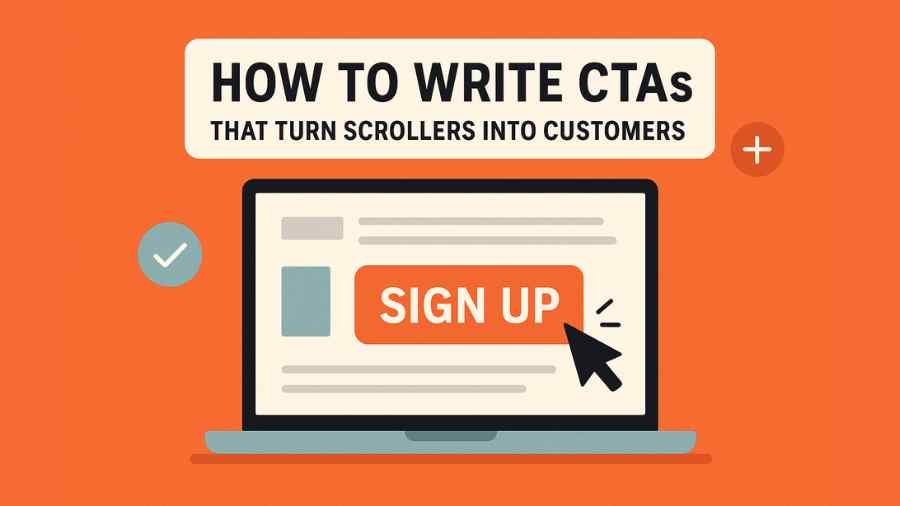
You scroll through sites every day, right? Most people do, and they skip right past weak calls to action. A strong CTA grabs attention and pushes visitors to act. It changes casual browsers into buyers or subscribers.
Think about your own site. Do your CTAs stand out? If not, you miss chances to grow your business. This guide walks you through steps to craft effective CTAs based on real data and examples. You will learn what works and why.
Understand What Action You Actually Want
Most businesses ask for the sale immediately. That’s the wrong move.
Your reader scrolled past 50 posts before seeing yours. They don’t know you. They haven’t seen your work. Asking them to buy now gets ignored.
Map out the journey from stranger to customer. The first interaction might be joining your email list. The second might be reading a free guide. The third might be watching a demo. Only then does the sale happen.
Your CTA at each stage should match where they are in that journey. Early stage readers get asked to subscribe. Mid-stage readers get asked to watch something. Late-stage readers get asked to buy.
Use Action Words That Create Clarity
Vague CTAs don’t work. “Learn more” could mean anything.
Compare these. “Learn more” versus “Watch the 5-minute demo.” “Discover our solution” versus “Download the free template.” “Find out how” versus “Read the case study.”
Specific action words tell readers exactly what they’ll do when they click. No guessing. No friction.
Your CTA should answer these questions. “Grab the checklist” answers all three. You’ll download something. It takes 30 seconds. You get a checklist.
Create Urgency With Real Scarcity
False urgency gets ignored. Real scarcity gets clicks.
“Buy today for a special price” sounds like every email you get. “The discount ends when this challenge finishes on Friday” sounds like something ending.
What scarcity actually exists in your business? Limited spots in a course. A sale that genuinely ends. Bonuses only available this week. Seasonal products. Exclusive pricing for early customers.
Use the scarcity that’s real. Don’t invent it.
Test One Element at a Time
You don’t know which CTA works best without testing.
Run version A for a week. “Join our email list.” Run version B for a week. “Get instant access to the template.” Track which gets more clicks.
Change only one thing between tests. Button color. Button text. Placement. One variable at a time shows you what actually matters.
Most marketers never test. They guess. Guessing loses money. Testing wins.
Make Your CTA Stand Out Visually
Use white space around it. Make the button bigger than the other elements. Use a different font. Do something that makes readers stop and notice. Buried CTAs get missed. Visible CTAs get clicked.
Match Your CTA to Your Traffic Source
Someone who lands on your page from an ad is primed to buy. Someone who lands on a blog post is learning.
Your blog post CTA might be “Subscribe for more articles like this.” Your ad CTA might be “Buy now and save 20 percent.”
The context tells you what action makes sense. Change your CTA based on where people came from.
Use Second Person Language
“Get access” is weak. “Get your access” is better.
Adding “your” makes the CTA personal. It’s talking to the reader directly. That shift matters.
Replace “Join today” with “Join us today.” Replace “Discover our platform” with “Discover your next opportunity.” The second version feels like it’s talking to you specifically.
Place Your CTA Where People Can’t Miss It
Top of page CTAs work. End of page CTAs work. Middle CTAs sometimes work. Your most important CTA should appear above the fold. For long-form content, repeat your CTA multiple times. Put it in the first section. Put it in the middle. Put it at the end. Repeat it in different ways.
Readers need exposure to your CTA multiple times before they click. One CTA buried in 2000 words gets missed.
Give People a Reason to Click Before You Ask
This is the biggest mistake. You ask for the click before explaining the value. Show the reader what they get. Show the benefit. Show why they should care. Then ask them to click.
“Watch our demo” is asking before explaining.
Align Your CTA to Your Business Goal
Different businesses have different CTAs that work.
An ecommerce store’s CTA is “Buy now.” A SaaS company’s CTA is “Start free trial.” A consultant’s CTA is “Book a call.” A newsletter’s CTA is “Subscribe.”
Your CTA should move people toward the outcome you actually want. If you want sales, ask for a sale. If you want email subscribers, ask for an email.
Misaligned CTAs waste traffic. You get clicks but not conversions.
Why Effective CTAs Matter?
Your traffic doesn’t convert itself into customers. You need to ask people to take action.
Most readers will do nothing unless you tell them what to do. Your CTA is that instruction.
Start testing today. Pick your current CTA. Write an alternative that’s more specific. Run both for a week. See which one wins. Do this once a month. Your job is to tell them clearly. That’s an effective CTA.
As you scale your testing and see patterns in what works, Subscriberz helps manage different CTA variations across channels so you’re always using your best-performing language.
Test. Measure. Refine. That’s how you turn scrollers into customers.