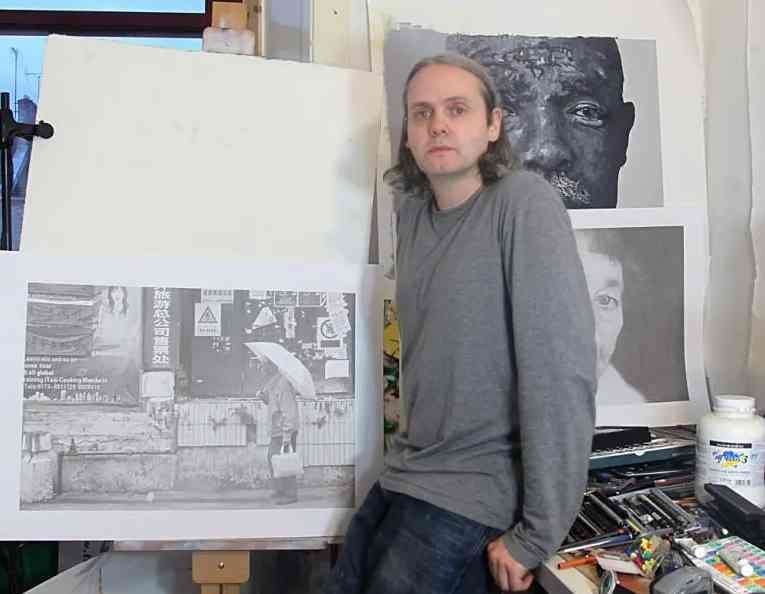
Few contemporary artists have blurred the line between photography and drawing as convincingly as Paul Cadden. Known for his astonishing hyperrealistic pencil works, he has earned international acclaim for images so precise and emotionally charged that viewers often question whether they are truly drawings at all. From humble beginnings in Glasgow to global recognition, his artistic journey is a compelling story of discipline, perception and relentless attention to detail.
Early Life and Artistic Foundations
Born in Glasgow in 1964, Paul Cadden developed an early interest in drawing and visual storytelling. Growing up in Scotland during a period of industrial and social transition, he was surrounded by a rich tapestry of urban life. The textures of city streets, the expressions of everyday people and the raw honesty of working-class environments would later become recurring themes in his art.
He studied Print Design at the Glasgow College of Building and Printing before advancing his education in animation and illustration at James Watt College. These formative years shaped his technical precision and compositional awareness. Training in print and animation cultivated patience and methodical execution, skills that would prove essential in the development of his hyperrealist approach.
Unlike many artists who move swiftly towards abstraction, he chose to pursue detail, realism and observational depth. That decision would define his career.
Understanding Hyperrealism
What Makes Hyperrealism Different?
Hyperrealism is often confused with photorealism, yet the two differ significantly. While photorealism aims to replicate a photograph faithfully, hyperrealism pushes beyond mere replication. It heightens reality, intensifying textures, shadows and emotional cues to create an image that feels even more vivid than life itself.
In the hands of Paul Cadden, hyperrealism becomes a means of storytelling. A wrinkle, a tear, a strand of hair or the roughness of stubble are not simply technical achievements; they are emotional signifiers.
The Illusion of Photography
Many first-time viewers assume his drawings are high-resolution photographs. Only upon closer inspection do they realise the image has been created entirely with graphite and pencil. The illusion arises from meticulous layering, tonal control and an exceptional understanding of light behaviour on skin and fabric.
The remarkable realism is not achieved through shortcuts. It requires hundreds of hours of disciplined labour on a single piece.
Technique and Process
Reference Imagery and Observation
Although his works appear spontaneous, the process is structured. He begins with photographic references, often capturing his own images. The photograph serves as a starting point rather than a limitation. During the drawing stage, he enhances subtle details, adjusting contrasts and emphasising particular features to deepen narrative impact.
This process allows Paul Cadden to interpret rather than merely reproduce.
Tools and Materials
His primary tools are graphite pencils, fine mechanical pencils and textured paper surfaces that allow controlled layering. The surface texture is crucial; it grips the graphite in minute quantities, enabling smooth gradients and detailed highlights.
Each drawing is built gradually, often over several weeks. Tiny strokes accumulate to create pores, eyelashes and reflections. Mistakes are not easily corrected, making precision essential from the outset.
Patience as Discipline
The discipline required cannot be overstated. Hyperrealism demands not only technical skill but also extraordinary concentration. Working on a large-scale portrait for over 100 hours requires physical endurance and mental resilience. The result, however, is a piece that commands attention in any gallery setting.
Themes and Subject Matter
Portraiture and Human Emotion
Much of Paul Cadden’s portfolio centres on portraiture. Faces are rendered with intense focus, often filling the frame. Tears suspended on eyelashes, damp strands of hair clinging to skin, or the quiet tension in a subject’s expression create powerful emotional resonance.
These portraits invite viewers to pause. They encourage reflection on vulnerability, humanity and the thought processes hidden behind a gaze.
Urban Narratives
Beyond portraiture, he has depicted urban scenes and everyday life. Market traders, street vendors and ordinary citizens appear in works that elevate routine moments into something monumental. The choice of subject reinforces the idea that beauty and complexity exist within common experiences.
The hyperreal style magnifies overlooked details, transforming ordinary subjects into compelling focal points.
International Recognition and Exhibitions
Throughout his career, Paul Cadden has exhibited extensively across the United Kingdom and internationally. London galleries have showcased his large-scale works, drawing collectors fascinated by technical excellence and conceptual depth.
His pieces have also been featured in prominent art publications and exhibitions across Europe and beyond. Collectors value not only the skill but also the rarity of such labour-intensive art. Each drawing represents weeks of concentrated effort, making them limited by nature.
Recognition has grown steadily rather than explosively. This gradual ascent reflects authenticity rather than trend-driven fame.
The Philosophy Behind the Detail
More Than Technical Mastery
While technical ability is immediately evident, the deeper value lies in perception. Hyperrealism challenges viewers to reconsider what they see. By presenting an image that appears photographic yet is handcrafted, Paul Cadden questions assumptions about reality and representation.
The viewer must confront the fact that perception can be manipulated through skill alone.
Slowing Down the Modern Gaze
In a digital age dominated by rapid scrolling and fleeting images, his drawings demand time. They reward patience. Standing before one of his large portraits, viewers often lean closer, searching for brushstrokes that do not exist. This slowing of the gaze becomes part of the artistic experience.
The artwork resists instant consumption.
Cultural and Artistic Impact
Hyperrealism is sometimes criticised for prioritising technique over imagination. However, in this case, technical mastery becomes the medium for conceptual exploration. Paul Cadden demonstrates that realism can be as intellectually engaging as abstraction.
His influence is evident among emerging artists who experiment with graphite realism. Art students frequently cite his works as benchmarks of detail and tonal control.
Moreover, his success reinforces the relevance of drawing in contemporary art. In an era dominated by digital installations and conceptual minimalism, his commitment to pencil on paper affirms the enduring power of traditional media.
The Market for Hyperrealist Art in the UK
Within the UK art market, hyperrealist drawing occupies a distinctive niche. Collectors appreciate the visible labour embedded in each piece. Galleries often highlight the time investment required, emphasising craftsmanship as a mark of value.
Works by Paul Cadden typically command significant prices, reflecting both demand and the scarcity inherent in such meticulous production. Because each piece requires extensive hours, output remains limited, maintaining exclusivity.
As British audiences continue to embrace figurative art, hyperrealism has secured a firm place in contemporary collections.
Challenges of the Medium
Producing hyperrealist drawings at scale presents physical and psychological challenges. Extended periods of intense focus can strain eyesight and posture. Precision must be maintained consistently, as minor tonal inconsistencies can disrupt the illusion.
Yet these challenges contribute to the authenticity of the finished work. They reinforce the sense that every millimetre has been intentionally crafted.
Why His Work Resonates Today
In a world saturated with filtered imagery and artificial enhancement, hyperrealism reconnects viewers with tangible craft. The authenticity of hand-drawn graphite stands in contrast to digital manipulation.
Paul Cadden captures humanity in a way that feels immediate and honest. The magnified details reveal imperfections that make subjects relatable. Viewers recognise the fragility and strength present in each expression.
This emotional accessibility explains the enduring appeal.
FAQs
Who is Paul Cadden?
Paul Cadden is a Scottish hyperrealist artist known for creating highly detailed graphite drawings that closely resemble high-resolution photographs.
What materials does he use?
He primarily works with graphite pencils and textured paper, building layers gradually to achieve depth and realism.
How long does one drawing take?
A single large-scale piece can require over 100 hours of careful, concentrated work.
Where has he exhibited in the UK?
His work has been displayed in London galleries and various exhibitions across the United Kingdom, attracting both national and international collectors.
Why are his drawings often mistaken for photographs?
The extraordinary tonal precision, lifelike textures and meticulous detailing create an optical illusion that closely mimics photographic clarity.
Conclusion
Paul Cadden stands as one of the most compelling hyperrealist artists working today. His graphite drawings transcend technical imitation, offering deeply human narratives rendered with astonishing precision. From Glasgow roots to international exhibitions, his journey reflects dedication, discipline and artistic conviction.
By magnifying the subtle details of everyday life, Paul Cadden reminds us that reality itself can be extraordinary when observed closely. His art challenges perception, slows the modern gaze and reaffirms the enduring power of traditional drawing in contemporary culture.