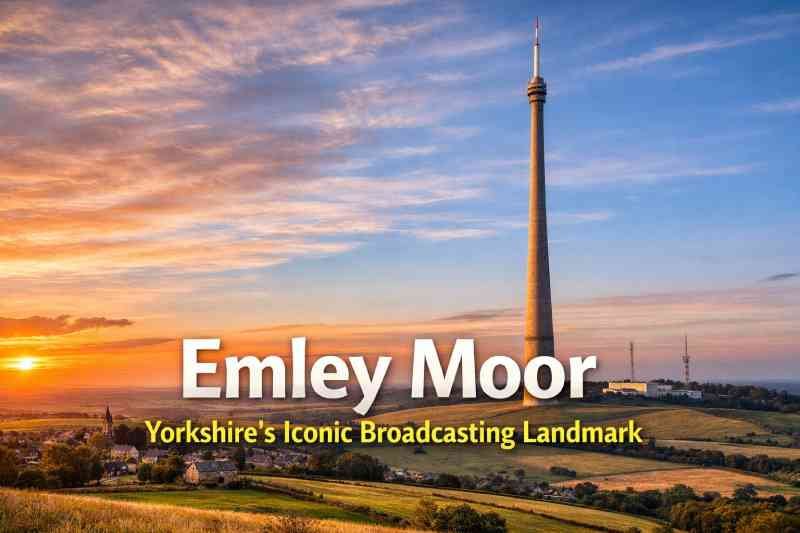
Emley Moor is one of Britain’s most recognisable landmarks, standing proudly above the rolling hills of West Yorkshire as a symbol of engineering ambition, regional identity, and broadcasting history. Rising dramatically above the countryside, the Emley Moor transmitting station is not merely a structure of steel and concrete; it is an icon that has shaped communication across vast parts of northern England for decades.
For many people travelling through Yorkshire, the sight of Emley Moor emerging above the horizon is both familiar and striking. Its elegant concrete tower dominates the skyline and serves as a reminder of Britain’s technological progress in television and radio transmission. Yet behind its impressive appearance lies a fascinating story involving innovation, disaster, reconstruction, and national significance.
What Is Emley Moor?
Emley Moor refers both to a geographical area in West Yorkshire and to the famous transmitting station located there. The site lies near the village of Emley, between Huddersfield and Wakefield, in an elevated rural setting that makes it ideal for broadcasting signals across a wide region.
The most prominent feature of Emley Moor is its transmission tower, officially known as the Emley Moor transmitting station. It is the tallest freestanding structure in the United Kingdom, reaching approximately 330.4 metres in height. Because of its extraordinary scale, it can be seen from many miles away and has become a defining landmark of Yorkshire.
Its primary function is to broadcast television and radio signals, serving millions of homes across northern England.
The Early History of Emley Moor Broadcasting
The story of Emley Moor begins in the mid-twentieth century, when Britain was rapidly expanding its television broadcasting network. As television ownership increased after the Second World War, the need for stronger and wider signal coverage became urgent.
The first transmission mast at Emley Moor was erected in the 1950s. This original structure was a lattice tower designed to carry broadcasting equipment high above the surrounding terrain. Its elevated location made it perfect for transmitting signals across Yorkshire and neighbouring counties.
As television technology developed, the original mast soon became insufficient. Engineers replaced it with a taller guyed mast in the 1960s to improve transmission capacity and signal reach. At the time, this mast represented a major advancement in broadcasting infrastructure.
However, this second structure would become famous for tragic reasons.
The Dramatic Collapse of 1969
One of the most dramatic events in British broadcasting history occurred on 19 March 1969, when the Emley Moor mast collapsed.
The 385-metre guyed mast, then one of the tallest structures in Europe, failed catastrophically during severe winter weather. Ice accumulation on the supporting guy wires created immense strain, and the structure could no longer withstand the pressure. The mast buckled and crashed to the ground.
The collapse caused significant disruption to television and radio services across large areas of northern England. Thousands of households lost reception, and engineers had to establish emergency temporary systems to restore broadcasting.
Remarkably, despite the scale of the collapse, there was no major loss of life. The disaster nevertheless forced a complete rethink of mast design and engineering safety.
Rebuilding Emley Moor: A New Era Begins
Following the collapse, authorities decided that a more durable and resilient structure was essential. Rather than constructing another guyed mast, engineers designed a reinforced concrete tower capable of standing independently without external support cables.
Construction of the current Emley Moor tower began shortly after the disaster, and the new structure was completed in 1971.
This replacement tower was revolutionary in British engineering. Built from reinforced concrete and designed to resist extreme weather conditions, it represented a significant leap forward in transmission tower design.
Unlike its predecessor, the new Emley Moor tower was self-supporting, reducing the risks associated with ice loading on guy wires.
Today’s tower remains one of the finest examples of broadcast engineering in Europe.
Engineering Brilliance Behind the Tower
The Emley Moor tower is remarkable not only for its height but also for its structural sophistication.
Height and Dimensions
Standing at 330.4 metres, the tower surpasses every other freestanding structure in the United Kingdom. Its sheer scale allows signals to travel across wide geographical areas without obstruction.
Concrete Design
The shaft of the tower is constructed from reinforced concrete, tapering elegantly as it rises. This shape enhances both stability and wind resistance.
Observation and Equipment Levels
Near the top of the tower sits a circular pod-like structure housing technical equipment, maintenance areas, and service facilities. Above this section rises the steel antenna mast that carries broadcasting apparatus.
Weather Resistance
Because Emley Moor stands in an exposed upland environment, it must endure strong winds, freezing temperatures, and severe storms. Its engineering design accounts for all these factors, ensuring long-term resilience.
Why Emley Moor Matters in Broadcasting
Emley Moor plays a central role in the UK’s communications network.
The transmitting station provides digital terrestrial television, FM radio, DAB radio, and other communication services to millions of people. Its coverage area spans much of Yorkshire, Derbyshire, Nottinghamshire, and surrounding regions.
Without Emley Moor, reliable broadcast access across northern England would be severely limited.
Its importance became even greater during the transition from analogue to digital broadcasting, as it supported modernisation efforts across the country.
Emley Moor and Yorkshire Identity
Beyond its technical role, Emley Moor holds deep cultural significance in Yorkshire.
For many residents, it is more than a communications tower. It is a landmark tied to memory, place, and identity. Whether glimpsed from motorways, hilltops, or village roads, the tower acts as a familiar navigational point and regional symbol.
Artists, photographers, and filmmakers frequently feature Emley Moor in creative works because of its distinctive silhouette and commanding presence.
It has become woven into the visual identity of Yorkshire itself.
Can You Visit Emley Moor?
The Emley Moor transmitting station is not generally open to the public for routine tourism. Unlike some observation towers around the world, it does not operate as a visitor attraction with public viewing decks.
Access is highly restricted due to operational broadcasting equipment and safety regulations.
However, the surrounding countryside offers excellent vantage points from which visitors can admire the tower. Many walkers and photographers visit nearby hills for panoramic views.
Special heritage events occasionally allow limited public access, though these are rare.
Fascinating Facts About Emley Moor
Tallest Freestanding UK Structure
Emley Moor is taller than The Shard in London and remains Britain’s tallest freestanding building or tower.
Visible Across Counties
On clear days, the tower can be seen from dozens of miles away across multiple counties.
Unique Shape
Its elegant tapered design makes it instantly recognisable compared with conventional steel lattice masts.
Grade II Listed Status
The structure is protected for its architectural and engineering significance.
Built After Disaster
The current tower owes its existence directly to lessons learned from the 1969 collapse.
Emley Moor in Modern Times
Today, Emley Moor continues to evolve with technology.
As broadcasting systems advance, the tower adapts to support new transmission formats and digital infrastructure. Engineers continually update equipment to meet modern communication demands.
Despite changing media habits, terrestrial broadcasting remains essential, particularly in rural communities where alternative infrastructure may be limited.
Emley Moor therefore remains as relevant today as ever.
Environmental and Landscape Impact
Because of its height and rural setting, Emley Moor has a dramatic effect on the surrounding landscape.
Some see it as an industrial intrusion into natural scenery, while others regard it as a graceful landmark blending modernity with countryside tradition.
Its visibility makes it a subject of debate in discussions about landscape preservation, yet it has become so embedded in Yorkshire’s visual character that many now consider it inseparable from the region.
The Legacy of Emley Moor
Few structures in Britain combine technological significance, historical drama, and cultural symbolism as powerfully as Emley Moor.
Its story reflects Britain’s broadcasting evolution, engineering resilience, and regional pride. From catastrophic collapse to triumphant rebuilding, Emley Moor represents progress born from adversity.
It stands today not only as a transmitter of signals, but as a transmitter of history, identity, and national achievement.
FAQs
Why did the original Emley Moor mast collapse?
The 1969 mast collapsed because ice built up heavily on its supporting guy wires during severe weather, causing structural failure.
How tall is the current Emley Moor tower?
The present Emley Moor tower stands approximately 330.4 metres tall, making it the tallest freestanding structure in the UK.
Does Emley Moor still broadcast television signals today?
Yes, Emley Moor remains a major active broadcasting station transmitting television, radio, and digital communication signals across northern England.
Conclusion
Emley Moor is far more than a towering structure on the Yorkshire skyline. It is a monument to engineering excellence, a cornerstone of British broadcasting, and a cherished regional landmark with a story unlike any other. From its early beginnings to its present-day role in digital communications, Emley Moor continues to serve millions while inspiring admiration across generations. Its legacy is secure, its importance undeniable, and its silhouette forever etched into the identity of Yorkshire.