Askham Richard: Discovering the History, Heritage and Rural Charm of a Timeless Yorkshire Village

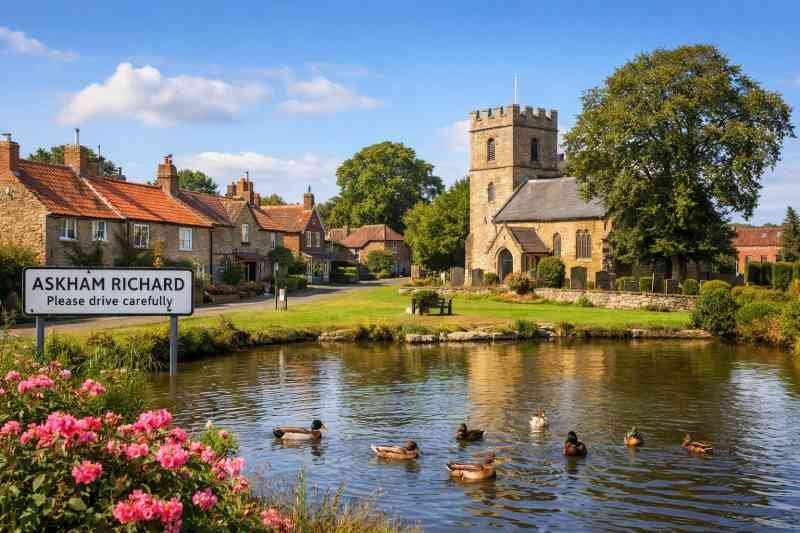
Askham Richard is one of those rare English villages that quietly captures the essence of rural Yorkshire without ever needing to announce itself loudly. Nestled in the countryside south-west of York, this historic village offers a remarkable blend of medieval heritage, architectural beauty, agricultural tradition and peaceful modern village life. Though modest in size, Askham Richard carries centuries of history within its lanes, stone buildings and village green, making it a place of both local significance and wider cultural interest.
In an age where many traditional English villages have lost much of their original character, Askham Richard remains an enduring example of preserved rural identity. Its conservation status, historic parish church, longstanding agricultural roots and carefully maintained landscape make it an exceptional subject for anyone interested in English village history, Yorkshire heritage or countryside tourism.
Where Is Askham Richard Located?
Askham Richard lies in North Yorkshire, within the unitary authority of the City of York, approximately 6.5 miles south-west of York itself. It is situated near neighbouring villages such as Askham Bryan, Bilbrough and Copmanthorpe, surrounded by open farmland and gentle rural scenery. Despite its close proximity to York, the village maintains a distinctly peaceful and separate identity.
Its location makes Askham Richard particularly appealing because it offers countryside tranquillity while remaining accessible to one of England’s most historic cities. Residents and visitors alike benefit from the balance between rural seclusion and urban convenience.
The Origins of the Name Askham Richard
The name Askham Richard has deep historical roots. The word “Askham” is believed to derive from Old English and Norse influences meaning “enclosure of ash trees” or “ash-tree settlement”. The “Richard” element is thought to refer to Richard, 1st Earl of Cornwall, whose association with land ownership in the region likely gave rise to the distinguishing suffix.
This naming tradition reflects a common medieval English practice where settlements were differentiated by attaching the names of landowners or noble patrons. The nearby village of Askham Bryan follows a similar pattern, illustrating how local governance and feudal ownership shaped regional place names.
Askham Richard in the Domesday Book
One of the most fascinating aspects of Askham Richard is its appearance in the Domesday Book of 1086, the great survey commissioned by William the Conqueror. This confirms that the village existed as a recognised settlement nearly a thousand years ago.
Before the Norman Conquest, the lands around Askham Richard formed part of a larger manor associated with Edwin, Earl of Mercia. Following the redistribution of land after 1066, ownership changed hands under Norman rule, embedding the village into England’s transformed feudal landscape.
Its Domesday presence gives Askham Richard an important historical pedigree, linking it directly to one of the foundational records of English land history.
The Historic Character of the Village
Askham Richard is widely admired for its remarkably preserved village layout. The settlement retains the classic form of a traditional English rural village, centred around a village green and duck pond, with houses and cottages arranged in a compact pattern around the main street.
Unlike heavily modernised commuter settlements, Askham Richard has retained much of its historic architectural rhythm. Stone-built cottages, farmhouses and heritage properties create a coherent visual identity that reflects centuries of continuity rather than rapid redevelopment.
The village was designated a Conservation Area in 1975, recognising its architectural and historic importance. This protection has helped preserve its traditional character and prevent inappropriate modern alterations.
St Mary’s Church: The Spiritual Heart of Askham Richard
At the centre of Askham Richard’s historical identity stands St Mary’s Church, one of its most treasured landmarks. This Grade II* listed parish church has origins stretching back to the Norman and possibly Saxon periods.
Although much of the visible structure reflects Victorian restoration work carried out in the nineteenth century, important earlier elements remain. These include Norman stonework and remarkable doorway carvings, some featuring zigzag mouldings typical of Romanesque ecclesiastical architecture.
The church is more than a religious building; it is a living record of architectural evolution across centuries. Its survival and careful preservation offer insight into both medieval worship and Victorian restoration practices in rural England.
Agricultural Roots and Rural Economy
Historically, Askham Richard has always been closely tied to agriculture. The surrounding land consists largely of fertile gravel and clay soils, well suited to farming. For centuries, agriculture shaped the village economy, land use and social structure.
Even today, farming remains part of the village identity, although the local economy has diversified. Some residents now commute to York or nearby towns for work, while others remain engaged in agricultural or land-based professions.
Nearby Askham Bryan College has also played a role in sustaining the agricultural character of the wider area, reinforcing the region’s longstanding connection with rural education and land management.
Askham Grange and Its Unique National Role
One of the most distinctive institutions associated with Askham Richard is HM Prison Askham Grange, located within the village. Opened in 1947, it was Britain’s first open prison for women.
This gives Askham Richard an unusual place in modern British penal history. Unlike traditional closed prisons, Askham Grange focuses on rehabilitation and resettlement, supporting women preparing to re-enter society.
Its presence adds an unexpected but important layer to the village’s identity, connecting this quiet rural settlement to national conversations about justice reform and rehabilitation.
Population and Community Life
Askham Richard has remained small throughout its history. Census records show gradual but modest population growth, preserving the intimate scale that defines village life. The 2011 census recorded a population of 351 residents.
This small population contributes to a strong sense of community cohesion. Village life is shaped by local traditions, parish activities and neighbourly familiarity that larger settlements often lose.
The parish council plays an active role in preserving village interests, maintaining community spaces and ensuring that development respects the historic character of the area.
Architectural Beauty and Conservation Importance
What makes Askham Richard especially attractive is the harmony of its built environment. Listed buildings, historic cottages, traditional farmhouses and stone boundary walls all contribute to a unified aesthetic rarely preserved so successfully.
The conservation designation ensures that architectural integrity remains central to planning decisions. This helps protect not only individual buildings but also the overall atmosphere that gives Askham Richard its unique charm.
The village represents a model example of how heritage preservation can sustain living communities rather than freeze them into museum pieces.
Why Visitors Are Drawn to Askham Richard
Though not a major tourist destination, Askham Richard appeals strongly to visitors seeking authentic Yorkshire village experiences. People are drawn by:
- Peaceful countryside walks
- Historic architecture
- Village green and duck pond scenery
- Heritage church exploration
- Proximity to York without urban crowds
Its understated charm is precisely what makes it memorable. Askham Richard rewards slower travel, careful observation and appreciation for quiet heritage.
Askham Richard in Modern Times
Today, Askham Richard balances tradition with contemporary rural living. Modern residents enjoy digital connectivity and access to nearby services while living within a setting shaped by centuries of continuity.
Unlike villages overwhelmed by suburban expansion, Askham Richard has managed to evolve without surrendering its essential character. This makes it increasingly valuable in a rapidly changing national landscape where authentic rural heritage is becoming rarer.
The Enduring Appeal of Askham Richard
Askham Richard endures because it represents something deeply rooted in English cultural identity: continuity between past and present. It is not merely a village with old buildings, but a living settlement where history remains visible in daily life.
Its lanes, church, green spaces and homes all tell interconnected stories of Norman conquest, medieval landholding, agricultural tradition, Victorian restoration and modern conservation.
For historians, travellers, heritage enthusiasts and residents alike, Askham Richard offers something increasingly precious: authenticity.
FAQs
What is Askham Richard best known for?
Askham Richard is best known for its preserved historic village character, St Mary’s Church, conservation area status, and its association with HM Prison Askham Grange.
Is Askham Richard worth visiting?
Yes, Askham Richard is worth visiting for those interested in historic Yorkshire villages, peaceful countryside settings and authentic English rural heritage.
How old is Askham Richard?
Askham Richard is at least over 900 years old, as it is recorded in the Domesday Book of 1086, though the settlement likely predates that record.
Conclusion
Askham Richard is far more than a small Yorkshire village on the map. It is a place where English history, rural tradition and architectural heritage continue to exist in meaningful harmony. From its Domesday origins to its preserved village green, from Norman church carvings to modern conservation efforts, Askham Richard stands as a remarkable example of enduring village identity.
In a world increasingly shaped by speed and change, Askham Richard reminds us of the quiet strength found in continuity, place and heritage. For anyone seeking the true spirit of rural England, this timeless Yorkshire village remains a deeply rewarding discovery.