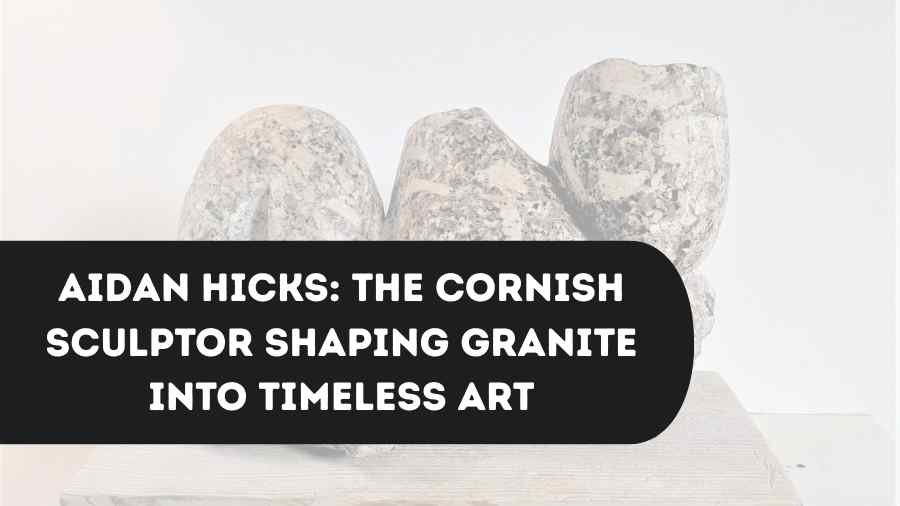
The name aidan hicks may not shout loudly in the global art world, yet within Cornwall and the British sculptural landscape, it resonates with quiet depth and authenticity. Hicks is a sculptor who works not merely with stone but with story, landscape, memory and material heritage. His practice emerges from the rugged Cornish terrain, shaped by granite, history, farm life, and a deep sense of belonging to the land that has nurtured generations. In an age of fleeting digital art and rapidly shifting trends, Hicks offers something rare: groundedness. His sculptures carry the weight of centuries, the texture of weathered earth, and the sincerity of craft rooted in place.
Early Life and Cornish Roots
Born in Penzance in 1966, aidan hicks grew up surrounded by the wild beauty of west Cornwall. The region is known for its granite tors, ancient stone structures, mining history and long-standing artistic communities. Artists have been drawn to Cornwall for generations, attracted by its dramatic coastlines, shifting light and rugged terrain. Hicks, however, was not merely an observer of the landscape—he lived in it, worked in it and eventually shaped art from it.
His early interest in drawing and painting hinted at a developing creative instinct, but his decision to study architecture and design provided him with a more structured understanding of form, proportion and spatial composition. Architecture taught him how materials behave, how weight generates presence and how form interacts with its surroundings. These lessons would later become fundamental to his sculptural voice.
In 1991, Hicks returned to the family farm in Cornwall. This move was more than a return to home—it was a return to the land and stone that would define his life’s work. Living and working on the farm connected him to the granite underfoot, giving him not only inspiration but also a source of material that carried personal, familial and cultural significance.
From Architecture to Sculpture
The transition from architecture to sculpture was gradual but natural. While architectural training sharpened his understanding of structure, Hicks found himself increasingly drawn to the immediacy of hands-on material work. Sculpture allowed him a freedom that architecture, bound by function, could not fully grant. It allowed intuition, instinct and material dialogue to drive the process.
Hicks experimented with various mediums before discovering his affinity for stone. Stone—specifically granite—was abundant on his land, but it also offered something deeper: history. Granite is ancient, dense, heavy and unyielding. It demands patience and respect. These qualities appealed to Hicks. Rather than shaping a compliant material into a predetermined vision, he engaged granite in a kind of partnership, responding to its natural character, its lines, its fractures and its inherent potential.
Working With Granite: Technique and Philosophy
Granite is notoriously difficult to work with. It is one of the hardest natural stones, requiring specialised tools, controlled force and an understanding of stress points. Hicks approaches the stone methodically yet sensitively. His aim is not to overpower the material but to reveal what is already present within it.
A core principle of Hicks’s work is authenticity. He often remarks that he wishes his finished sculptures to appear as though they emerged from the earth fully formed. This does not mean that he avoids shaping or refining the material; instead, he works in harmony with the natural lines and structures of the granite. The result is sculpture that feels ancient, elemental and inherently believable.
His technique is influenced by archaeology and the study of ancient objects. Hicks is fascinated by how weathering, erosion and time alter the meaning of artefacts. Old sculptures, monoliths and standing stones acquire ambiguity across centuries—original meanings fade, and new interpretations arise. This temporal transformation inspires Hicks. He shapes his granite pieces with an awareness of how they may evolve visually and conceptually long after he is gone.
Themes That Define His Work
1. Connection to Place
No theme in Hicks’s work is more dominant than the connection between human beings and the land they inhabit. By using granite sourced from his own family’s land, Hicks creates work that is deeply personal. The material carries the memory of the place, its geology and its history. The sculptures become both artistic expressions and extensions of the landscape.
2. Time and Permanence
Sculpture, particularly in stone, is an art form that interacts with time rather than resisting it. Hicks embraces this. His works feel both contemporary and ancient, as though they belong to a timeline far broader than the human lifespan. Granite, with its millions of years of natural formation, brings permanence to his art.
3. Minimalism and Honesty of Form
Hicks avoids flashy forms or exaggerated symbolism. His titles are simple, often referencing only the year, material and number. His forms are minimal yet monumental. This understated approach is intentional: he wants the stone’s natural presence to remain visible. He rejects unnecessary embellishment in favour of clarity, purity and respect for material.
4. Human Relationship to Stone
His sculptures frequently evoke the human figure or natural forms without explicitly mimicking them. The pieces feel familiar, suggestive and symbolic, yet they resist direct interpretation. Hicks believes that the viewer’s emotional response is as important as the sculptor’s intent.
Exhibition Work and Artistic Recognition
Though rooted in Cornwall, the work of aidan hicks has found appreciation beyond the region. He is associated with respected artistic organisations, including the Penwith Society of Artists, a historic community founded by influential modernists. His participation in exhibitions—both solo and collaborative—reflects a growing interest in his sculptural voice.
Hicks’s work appeals to those who value authenticity, material storytelling and sculptural craft. Collectors often admire the physicality and tactile presence of his sculptures. Granite pieces, even when modest in size, possess undeniable weight and authority.
Why Aidan Hicks Stands Out in Contemporary British Sculpture
In an era dominated by digital forms, conceptual installations and transient media, Hicks represents a powerful countercurrent. His sculptures are made to last. They are heavy, grounded and tangible. Contemporary culture often prioritises speed and novelty, yet Hicks invites slowness and contemplation.
His work reflects not just artistic skill but a philosophy of life rooted in respect for heritage and the natural world. He crafts objects that feel timeless because they emerge from time itself—from granite shaped by geological forces long before humans existed.
Appreciating His Sculptures: A Viewer’s Guide
To properly appreciate the work of aidan hicks, viewers should consider:
- Material presence: Granite is dense and powerful; notice how the weight influences the sculpture’s character.
- Surface texture: Observe the combination of rough and refined areas.
- Light interaction: Granite responds subtly to light; shadows emphasise its forms.
- Emotional effect: Hicks’s pieces often evoke stillness, strength, and geological memory.
- Context: Consider how the sculpture would appear outdoors, where natural light and weather might enhance its qualities.
Potential Future Directions
As interest in sustainable, material-led and site-specific art grows, Hicks’s work may gain wider acclaim. Granite, as a natural and durable material, resonates with modern environmental consciousness. His emphasis on local sourcing further enhances this connection.
Future possibilities include:
- Larger public installations
- Expanded exhibitions across the UK and Europe
- Collaborations with architects or landscape designers
- Comprehensive catalogues documenting his evolving body of work
Conclusion
The keyword aidan hicks represents far more than a name; it signifies an artistic philosophy grounded in authenticity, nature and heritage. As a sculptor, Hicks transforms ancient granite into contemporary expressions of place, time and identity. His work invites viewers to slow down, observe and reconnect with materials that predate civilisation itself. In a world that often values speed over substance, aidan hicks stands as a reminder of the enduring beauty found in stone, craft and quiet artistry.