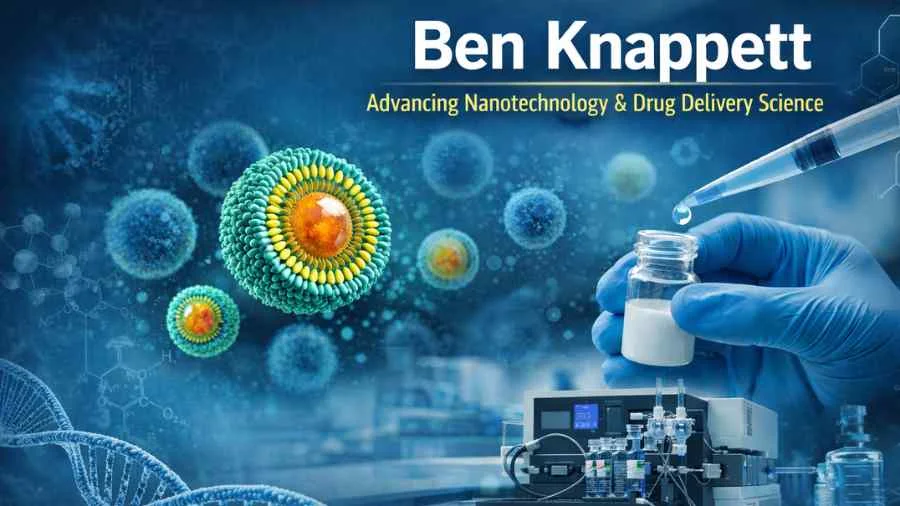
In the rapidly evolving world of nanotechnology and pharmaceutical science, certain researchers stand out not because of celebrity, but because of sustained, practical impact. Ben Knappett belongs firmly in that category. Known for his work at the intersection of chemistry, nanomaterials, and drug delivery systems, Ben Knappett has built a reputation grounded in rigorous science, applied innovation, and real-world relevance. His career reflects a broader shift in modern research: moving beyond theory towards technologies that enable safer, more effective medicines.
Early Academic Foundations in Chemistry
Ben Knappett’s scientific journey began with a strong academic foundation in chemistry. He pursued an MChem degree, a qualification that blends undergraduate study with advanced research-led training. This phase of his education established his core strengths in analytical thinking, laboratory practice, and materials science.
Chemistry at this level is not limited to textbook learning. It involves hands-on experimentation, data interpretation, and a deep understanding of molecular behaviour. For Knappett, this period laid the groundwork for his later focus on nanoparticles, where precision at the molecular and nanoscale level is essential.
Doctoral Research and Nanoparticle Science
Following his master’s studies, Ben Knappett completed a PhD focused on nanoparticle synthesis and characterisation. Doctoral research in this area demands both technical expertise and creative problem-solving. Nanoparticles behave differently from bulk materials, and understanding their structure, stability, and interaction with biological systems requires advanced methods and careful experimentation.
His doctoral work centred on producing nanoparticles with controlled size, shape, and composition, as well as developing methods to characterise them accurately. Techniques such as electron microscopy, spectroscopy, and diffraction analysis form the backbone of this research. Through this work, Knappett developed a deep understanding of how nanoscale properties influence real-world performance, a theme that would continue throughout his career.
Understanding Nanoparticles and Their Importance
To appreciate Ben Knappett’s contribution, it is important to understand why nanoparticles matter. Nanoparticles typically range from one to one hundred nanometres in size. At this scale, materials exhibit unique optical, chemical, and biological properties.
In medicine, nanoparticles are particularly valuable because they can be engineered to carry therapeutic agents directly to specific cells or tissues. This targeted approach can improve drug effectiveness while reducing side effects. Lipid nanoparticles, for example, have become central to modern vaccine and gene therapy development.
Knappett’s expertise sits precisely at this critical intersection between material design and biomedical application.
Transition from Academia to Applied Science
Unlike some researchers who remain solely within academic institutions, Ben Knappett moved into applied science roles that connect laboratory research with industry needs. This transition reflects a growing trend in scientific careers, where researchers seek to translate discoveries into usable technologies.
In applied roles, the challenge shifts. The focus is not only on whether something works in a laboratory, but whether it can be reproduced, scaled, and integrated into broader workflows. Knappett’s background in nanoparticle synthesis positioned him well to address these challenges.
Microfluidics and Controlled Particle Formation
One of the defining features of Ben Knappett’s professional work has been his involvement with microfluidics-based nanoparticle production. Microfluidics involves manipulating very small volumes of fluids through precisely engineered channels. This technology allows for exceptional control over mixing conditions, reaction times, and particle formation.
For nanoparticle synthesis, microfluidics offers several advantages:
- Greater reproducibility compared to traditional batch methods
- Precise control over particle size and distribution
- Easier scaling from research to production
Knappett played a key role in developing and supporting platforms that enable scientists to move from exploratory research to consistent, repeatable nanoparticle formulation.
Lipid Nanoparticles and Drug Delivery Systems
A significant portion of Ben Knappett’s work focuses on lipid nanoparticles, commonly known as LNPs. These structures are composed of lipids that self-assemble into particles capable of encapsulating nucleic acids or small-molecule drugs.
LNPs have gained global attention due to their role in delivering mRNA-based vaccines and emerging gene therapies. However, designing effective LNPs is complex. Variables such as lipid composition, particle size, surface charge, and stability all influence performance.
Knappett’s contribution lies in helping researchers optimise these variables using automated and high-throughput approaches. By enabling systematic testing and refinement, his work supports faster development cycles and more reliable outcomes.
Bridging Research and Manufacturing
One of the most difficult steps in pharmaceutical development is the transition from laboratory research to manufacturing. Processes that work at a small scale often encounter problems when expanded to production levels.
Ben Knappett’s work addresses this gap directly. By focusing on scalable, controlled formulation technologies, he helps ensure that nanoparticle systems developed in research settings can be reproduced under manufacturing conditions. This alignment between early-stage experimentation and later-stage production is critical for reducing development risk and cost.
Leadership in Scientific and Technical Roles
Beyond his technical expertise, Ben Knappett has taken on leadership responsibilities within scientific organisations. These roles require a different skill set, including communication, strategic planning, and collaboration across disciplines.
Leading scientific teams involves balancing innovation with practicality. It means supporting researchers, understanding customer or user needs, and translating complex science into accessible concepts. Knappett’s ability to operate at this level has amplified the impact of his technical knowledge.
Contributions to Scientific Communication
In addition to hands-on research and development, Ben Knappett has contributed to scientific communication through authored articles and expert discussions. Clear communication is essential in advanced fields like nanotechnology, where misunderstandings can easily arise.
His written contributions focus on explaining how new tools and methodologies can improve nanoparticle research and drug delivery. Rather than promoting abstract theory, these writings emphasise practical application, helping readers understand how technology choices affect experimental outcomes.
Influence on Modern Nanomedicine
While Ben Knappett may not be a household name, his influence is evident within the scientific and pharmaceutical communities. By enabling better tools, clearer workflows, and more reproducible results, his work indirectly supports advances in medicine that affect millions of people.
Nanomedicine relies heavily on collaboration between chemists, biologists, engineers, and clinicians. Knappett’s career reflects this collaborative reality. His role has often been to connect these disciplines through shared platforms and methodologies.
Ethical and Practical Considerations
Advanced technologies like nanoparticle drug delivery raise important ethical and practical questions. Safety, quality control, and regulatory compliance are all essential considerations.
Ben Knappett’s focus on characterisation and reproducibility contributes to addressing these concerns. Thorough understanding of nanoparticle behaviour reduces uncertainty and supports safer development pathways. In this sense, his work aligns scientific progress with responsible innovation.
Relevance for Students and Early-Career Scientists
For students considering a career in nanotechnology or pharmaceutical science, Ben Knappett’s path offers valuable lessons. His journey demonstrates that strong fundamentals in chemistry can lead to diverse opportunities, from academic research to applied technology and leadership roles.
It also highlights the importance of adaptability. As scientific priorities shift, the ability to learn new tools and engage with interdisciplinary teams becomes increasingly important. Knappett’s career illustrates how technical depth and flexibility can coexist.
The Broader Impact of Applied Nanoscience
Nanotechnology is often portrayed as futuristic or abstract, but its real value lies in application. Drug delivery systems, diagnostic tools, and advanced materials all depend on reliable nanoscale engineering.
By focusing on the practical aspects of nanoparticle production and characterisation, Ben Knappett contributes to making nanoscience usable rather than theoretical. This applied perspective ensures that scientific advances translate into tangible benefits.
Conclusion
Ben Knappett represents a modern scientific professional: technically skilled, application-focused, and committed to bridging the gap between research and real-world impact. His work in nanoparticle synthesis, microfluidics, and lipid nanoparticle formulation has supported advances in drug delivery and nanomedicine at a critical moment in pharmaceutical development.
Through a combination of academic rigour, applied innovation, and leadership, he has helped shape how nanoparticles are designed, tested, and scaled. While his name may not dominate headlines, the technologies and methodologies he supports play a vital role in contemporary science and medicine.