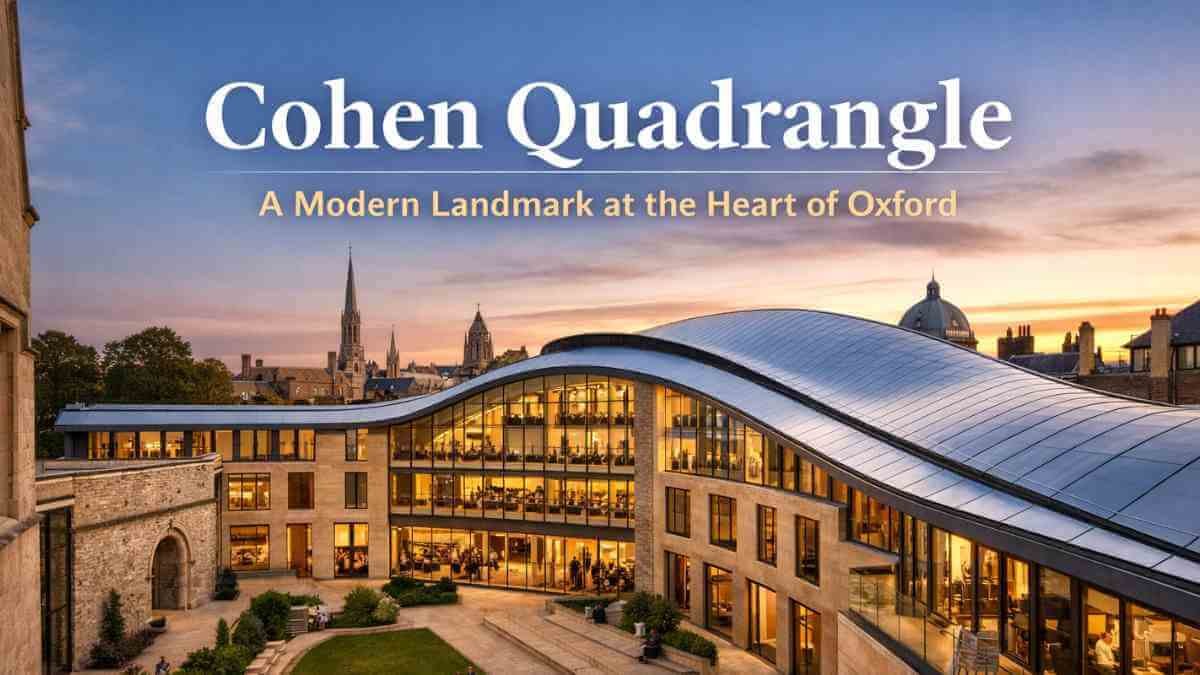
The Cohen Quadrangle is one of the most significant architectural additions to the University of Oxford in the modern era. Combining academic tradition with contemporary design thinking, it represents a thoughtful evolution of the classic Oxford college quad. Situated slightly away from the medieval core of the city, this striking development has reshaped how students live, learn, and interact within a collegiate environment.
Understanding the Idea of the Quadrangle at Oxford
The Traditional Oxford Quad
For centuries, Oxford colleges have been defined by the quadrangle: an enclosed courtyard surrounded by teaching rooms, accommodation, and communal spaces. These quads created order, privacy, and a strong sense of academic community. Their proportions and symmetry reflected stability and continuity.
A Modern Interpretation
The cohen quadrangle does not reject this tradition; instead, it reinterprets it. Rather than a single closed square, the design introduces a flowing form that creates multiple courtyards and social zones. This approach reflects how modern academic life works: collaborative, flexible, and interconnected rather than rigidly separated.
The Origins of Cohen Quadrangle
Expansion Beyond the Historic Centre
Exeter College, one of Oxford’s oldest colleges, faced a familiar challenge: limited space within the historic city centre. To accommodate a growing student population and modern teaching needs, the college acquired a site in Jericho, a vibrant area of north-west Oxford.
This location allowed the college to think boldly, free from some of the physical constraints that define central Oxford.
From Ruskin College to Cohen Quad
Before redevelopment, the site housed buildings associated with Ruskin College. Parts of the existing structure were carefully retained and integrated into the new design, ensuring continuity with the area’s educational heritage. The result is a building that feels rooted in its surroundings rather than imposed upon them.
Architectural Vision and Design Philosophy
The Role of the Architects
The project was designed by Alison Brooks Architects, a practice known for combining strong conceptual ideas with human-centred spaces. Their approach focused on how students move, meet, and learn, rather than simply how a building looks from the outside.
Organic Form and Flow
Unlike the rigid geometry of traditional quads, the cohen quadrangle follows a sinuous, curved form. This creates a sequence of spaces that gradually reveal themselves as you walk through the building. The experience is intentionally varied: narrow passages open into broad courtyards, quiet study areas lead into lively communal zones.
Materials and Visual Identity
The exterior combines stone, glass, and metal in a way that echoes Oxford’s historic palette while remaining unmistakably modern. The curved roofline, clad in metal, has become one of the building’s most recognisable features, visible from several points in Jericho and beyond.
Academic and Residential Functions
Student Accommodation
A major purpose of the cohen quadrangle is student housing. The building provides high-quality en-suite rooms designed to balance privacy with community living. Rooms are arranged in clusters that encourage social interaction without sacrificing personal space.
Natural light, acoustic comfort, and views into the courtyards all contribute to a calm and supportive living environment.
Teaching and Learning Spaces
Beyond accommodation, the cohen quadrangle includes lecture theatres, seminar rooms, and tutorial spaces. These are equipped to support modern teaching methods, from small group discussions to larger presentations.
The layout ensures that learning spaces are never isolated. Students often pass through shared areas on their way to classes, reinforcing the sense that learning is a collective experience.
The Learning Commons
At the heart of the building is the Learning Commons, a multi-level social and academic hub. This space is designed for informal study, group work, and chance encounters. It embodies a shift away from silent, isolated study towards collaborative learning that reflects real-world professional environments.
Relationship with Oxford and Jericho
A Bridge Between College and City
While the cohen quadrangle belongs to Exeter College, it also engages with the surrounding neighbourhood. Ground-level spaces and visual connections make it feel open rather than insular. This is a subtle but important departure from the inward-looking nature of many historic quads.
Respecting Context
Despite its contemporary form, the building respects the scale and rhythm of Jericho’s streets. It does not dominate its surroundings but adds a new layer to the area’s architectural story.
Cultural and Symbolic Significance
A Statement of Modern Values
The cohen quadrangle symbolises a broader shift in how universities see themselves. It reflects values such as inclusivity, collaboration, and adaptability. The building’s openness and fluidity mirror an academic culture that values exchange of ideas over hierarchy.
Representation and Progress
The project is also notable for being designed by a female-led architectural practice, marking a meaningful moment in a field historically dominated by men. This aligns with the university’s wider efforts to promote diversity and representation.
Sustainability and Long-Term Thinking
Environmental Considerations
Sustainability played an important role in the design process. Natural ventilation, efficient insulation, and careful orientation help reduce energy consumption. The courtyards support daylight penetration and create microclimates that improve comfort throughout the year.
Designed to Endure
Rather than chasing short-term architectural trends, the cohen quadrangle was designed with longevity in mind. Its materials, layout, and adaptability ensure that it can evolve alongside future generations of students.
Student Experience and Daily Life
Living and Learning Together
One of the most distinctive aspects of the cohen quadrangle is how seamlessly it blends residential and academic life. Students do not simply sleep there and study elsewhere; instead, daily routines unfold within a single, interconnected environment.
Building Community
Shared kitchens, study areas, and social spaces encourage students from different disciplines and backgrounds to interact. Over time, this fosters a strong sense of belonging and college identity, even though the site is physically separate from Exeter College’s historic centre.
The Wider Impact on University Architecture
Setting a New Benchmark
Since its completion, the cohen quadrangle has been widely discussed as a model for future university developments. It demonstrates that respecting tradition does not require copying the past. Instead, it shows how core principles can be reimagined for modern needs.
Influence Beyond Oxford
The ideas tested here, such as integrated living-learning environments and fluid spatial organisation, are now influencing campus projects across the UK and beyond.
Conclusion
The Cohen Quadrangle stands as a powerful example of how historic institutions can evolve without losing their identity. By blending tradition with innovation, it provides a living and learning environment that reflects modern academic values while remaining unmistakably part of Oxford. More than just a building, it is a statement about the future of university life: open, connected, and thoughtfully designed to support both scholarship and community.
FAQs
What is the main purpose of the cohen quadrangle?
The cohen quadrangle primarily serves as student accommodation and teaching space for Exeter College, combining living, learning, and social facilities in one integrated environment.
Where is the cohen quadrangle located?
It is located in the Jericho area of Oxford, slightly north-west of the city centre, providing Exeter College with valuable space beyond its historic site.
Why is the cohen quadrangle considered unique?
It reinterprets the traditional Oxford quadrangle using a contemporary, curved design that promotes openness, collaboration, and community.
Who designed the cohen quadrangle?
The building was designed by Alison Brooks Architects, a UK-based practice known for innovative and human-centred architecture.
Can the cohen quadrangle be visited by the public?
While primarily a student and academic facility, parts of the site are visible from surrounding streets, allowing the public to appreciate its architecture.