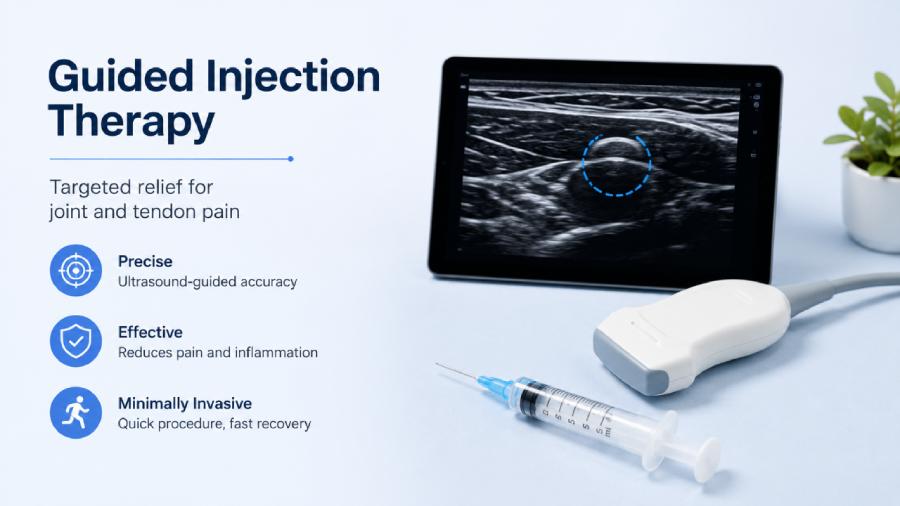
Persistent joint or tendon pain has a way of quietly shrinking your world — the walk you stop taking, the gym session you skip, the sleep you lose because your shoulder won’t let you get comfortable. For many people, painkillers and physiotherapy only go so far, and surgery feels like a disproportionate next step. Guided injection therapy sits in the middle: a targeted, minimally invasive treatment that’s often overlooked simply because people don’t know it exists.
What makes it “guided”?
Traditional injections are given based on anatomical landmarks and feel — usually accurate, but not always precise. Guided injection therapy uses real-time ultrasound imaging so the clinician can see the needle tip and the target tissue at the same time, placing the medication exactly where it needs to go. That precision tends to mean better outcomes and a lower risk of missing the mark, particularly in smaller or trickier joints.
What conditions is it used for?
Guided injections are used across a wide range of everyday complaints: frozen shoulder, tennis and golfer’s elbow, trigger finger, carpal tunnel-related discomfort, trochanteric bursitis of the hip, plantar fasciitis, and general osteoarthritis pain in the knee, hip, or shoulder. If physiotherapy has plateaued or pain is limiting basic daily activity, it’s usually worth discussing whether an injection could help.
Steroid, cortisone, or something else?
Not every injection uses the same medication, and the right choice depends on the joint and the underlying problem. Steroid and cortisone injections remain the most established option for reducing inflammation and pain quickly, often within a few days, and the effects can last anywhere from several weeks to several months. Other options — such as hyaluronic acid for osteoarthritis, or platelet-rich plasma (PRP) for tendon healing — are typically considered when a longer-term or regenerative approach is more appropriate.
What does the procedure actually involve?
Most guided injections take well under half an hour from start to finish. The area is scanned first to confirm exactly where treatment is needed, a local anaesthetic is often used to keep things comfortable, and the injection itself takes moments once the needle is correctly positioned. Most people are able to go straight back to normal (non-strenuous) activity the same day.
Is it right for you?
Guided injection therapy isn’t a cure-all, and it works best as part of a broader plan that may still include physiotherapy or lifestyle changes. But for pain that’s resistant to first-line treatment, it offers a genuinely useful middle ground — more targeted than a standard injection, far less invasive than surgery, and often the difference between managing pain and finally getting back to normal life.