Velodyne Lidar Inc emerged as one of the most influential companies in the field of light detection and ranging (lidar) technology. Over the last two decades, this innovative firm shaped the trajectory of autonomous vehicles, robotics, smart cities and industrial automation. The journey of Velodyne Lidar Inc reflects not only a technological revolution but also the changing landscape of high-tech industries, from start-up ingenuity to public listing and eventual strategic merger.
The Origins of Velodyne Lidar Inc
The story of Velodyne Lidar Inc began in California, where founder David Hall, an audio engineer and inventor, operated Velodyne Acoustics, a respected name in high-end audio equipment. In the mid-2000s, Hall turned his attention to lidar while preparing for the 2007 DARPA Urban Challenge, a government-sponsored competition that spurred innovation in self-driving car technology. Hall and his team developed a groundbreaking multi-beam spinning lidar sensor, which offered 360-degree environmental scanning at unprecedented resolution and speed. This invention laid the foundation for modern autonomous vehicle perception systems and established Velodyne Lidar Inc as a pioneer in its field.
Core Technology and Innovations
Lidar, which stands for light detection and ranging, works by emitting pulses of laser light and measuring the time it takes for them to return after reflecting off objects. This enables the creation of precise three-dimensional maps of the surrounding environment. Velodyne Lidar Inc advanced this technology by designing compact, high-performance sensors capable of scanning entire surroundings in real time. Its key innovation was the rotating multi-beam design, which combined multiple laser emitters and receivers on a spinning assembly. This design captured millions of data points per second and produced highly accurate 3D point clouds, even in challenging weather or lighting conditions.
The company’s engineering excellence allowed it to improve range, accuracy and reliability over successive generations of sensors. This made its products highly attractive to a range of industries beyond autonomous vehicles, including robotics, mapping, industrial safety, and smart city infrastructure. The adaptability of its technology reinforced Velodyne’s reputation as the gold standard in lidar performance.
Iconic Products that Defined an Industry
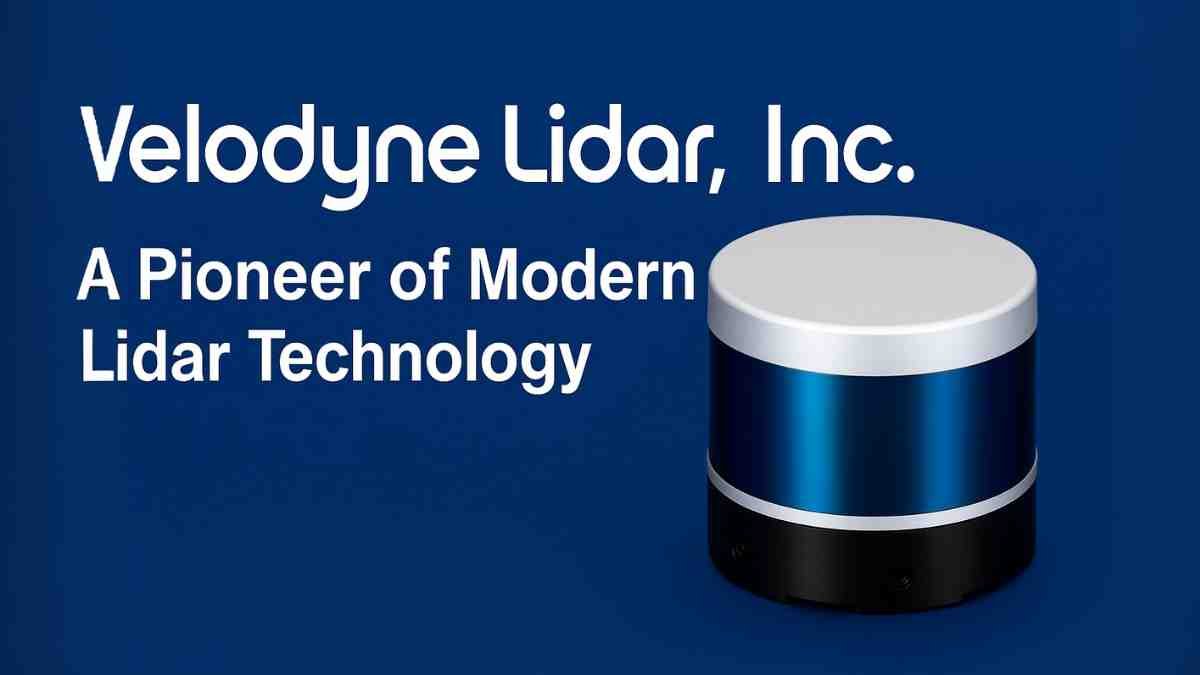
Several flagship products came to symbolise Velodyne Lidar Inc’s influence. The HDL-64E was its early flagship, featuring sixty-four laser beams and providing unmatched detail for early self-driving prototypes. Its distinctive rotating dome became an iconic sight atop experimental driverless cars. Another landmark product was the VLP-16, widely known as the “Puck”, a smaller and more affordable sensor that brought high-quality lidar within reach of robotics researchers and commercial developers worldwide. These and other models, such as the Velarray solid-state series, gave engineers flexibility to integrate lidar into a variety of applications, from aerial drones to industrial automation.
Velodyne’s approach to product development focused on consistent accuracy, reliability and ease of integration. The company continually refined the balance between performance and cost, helping to accelerate the adoption of lidar across different sectors. Its sensors became synonymous with early autonomous vehicle testing, and they remain a reference point for many competing manufacturers.
Business Growth and Public Listing
Building on its technological success, Velodyne Lidar Inc attracted partnerships with major automotive and technology firms. As self-driving research gained momentum, demand for high-quality lidar sensors surged. To capitalise on this growth, the company pursued a public listing through a special purpose acquisition company (SPAC) in 2020. This move provided capital to expand manufacturing, research and commercial operations. Under the ticker symbol VLDR, Velodyne became one of the first lidar firms to trade publicly, signalling the maturity of the lidar market.
The public listing brought both opportunities and challenges. While it gave Velodyne visibility and investment, the wider market for autonomous vehicles proved more volatile than expected. Competition increased as numerous lidar start-ups entered the scene, each promising cheaper or more advanced technology. At the same time, automotive manufacturers shifted timelines for deploying fully autonomous vehicles, slowing the pace of large-scale sensor procurement. Velodyne had to navigate this dynamic environment while sustaining its reputation for innovation.
Strategic Merger and Transition to Ouster
In 2023, Velodyne Lidar Inc entered a new chapter when it merged with Ouster, another prominent lidar manufacturer. Under the agreement, each Velodyne share converted into a fraction of an Ouster share, and Velodyne ceased trading as an independent company. The combined entity retained the Ouster name and ticker symbol, creating a stronger player with a wider customer base and a more diversified product line.
This merger was a strategic response to the competitive and capital-intensive lidar market. By uniting their intellectual property, research teams and distribution networks, Velodyne and Ouster aimed to accelerate development and reduce costs. Although the Velodyne brand no longer exists as a standalone company, its technologies and product designs continue to influence Ouster’s offerings. The legacy of Velodyne Lidar Inc thus lives on in the next generation of lidar products and applications.
Applications Across Industries
While autonomous vehicles remain the most high-profile application of lidar, Velodyne Lidar Inc’s technology reached far beyond self-driving cars. In robotics, its sensors enabled precise navigation for warehouse automation and service robots. In mapping and surveying, Velodyne lidar provided detailed three-dimensional data for construction, mining and environmental monitoring. Municipalities used its systems to enhance traffic management, monitor infrastructure and improve public safety in smart city projects. Even in agriculture, lidar helped optimise crop management and monitor terrain.
The breadth of these applications underscores the versatility of Velodyne’s technology. By delivering accurate, real-time 3D data, its sensors became essential tools for engineers and researchers across multiple disciplines. This wide adoption has ensured that the influence of Velodyne Lidar Inc continues even after its merger into Ouster.
Market Influence and Legacy
Velodyne Lidar Inc was more than a technology supplier; it was a catalyst for an entire industry. Its pioneering rotating multi-beam sensors set the standard for performance and reliability. The company’s early dominance pushed competitors to innovate, spurring rapid improvements in lidar technology across the market. Many of the practices and design principles introduced by Velodyne remain benchmarks for modern lidar manufacturers.
The company’s journey from a small audio engineering firm to a global technology leader highlights the transformative power of innovation. Its decision to merge with Ouster reflects the realities of a maturing industry, where consolidation is often necessary to maintain growth and sustain research investment. Yet Velodyne’s core contributions—its patents, designs and engineering expertise—will continue to shape lidar technology for years to come.
Future Outlook for the Combined Entity
Looking ahead, the Ouster-Velodyne merger positions the combined organisation to address a wide range of market needs. Ouster has already signalled its intention to leverage Velodyne’s proven sensor designs while expanding into new areas such as industrial automation, robotics and infrastructure monitoring. The demand for accurate, reliable 3D perception continues to grow, not only in automotive sectors but also in emerging fields like physical artificial intelligence and smart infrastructure.
For researchers, developers and investors, the story of Velodyne Lidar Inc provides valuable insight into the evolution of frontier technologies. It shows how a single breakthrough—in this case, a multi-beam spinning lidar—can trigger an entire ecosystem of innovation. As Ouster carries this legacy forward, Velodyne’s influence will remain a defining force in the lidar industry.
Conclusion
Velodyne Lidar Inc stands as a remarkable example of technological ingenuity and strategic adaptation. From its origins in audio engineering to its pioneering role in autonomous vehicle perception, the company transformed the possibilities of 3D sensing. Its products—especially the HDL-64E and the compact VLP-16 “Puck”—became symbols of lidar excellence and enabled breakthroughs across robotics, mapping, smart cities and beyond. Though Velodyne no longer operates independently, its merger with Ouster ensures that its innovations and expertise continue to drive progress. The name Velodyne Lidar Inc may now belong to history, but its contributions to modern technology will resonate far into the future.