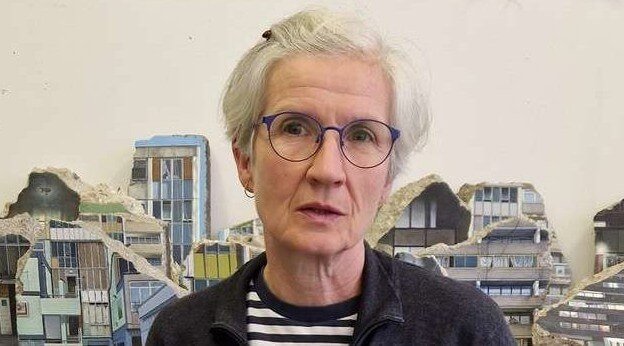
The name Harriet Mena Hill holds a distinguished place in contemporary British art. She is known not only for her extraordinary technical ability but also for her deep emotional and intellectual engagement with subjects like memory, architecture, and the human experience of space. Over the years, she has developed a distinctive artistic language that blends precision, geometry, and sentiment, inviting viewers to pause and reflect on the fragile connection between people and the environments they inhabit. Her work resonates as both a visual and emotional archive of change, preservation, and identity.
Early Life and Education
Harriet Mena Hill was born in London, with her birth year cited as either 1966 or 1968. From her earliest days, she displayed a fascination with architectural spaces, geometry, and human surroundings. She pursued formal art education at the Camberwell School of Arts & Crafts, where her understanding of form, space, and technique matured significantly. Her years at Camberwell were instrumental in shaping her aesthetic sensibilities and in helping her discover how deeply personal and psychological experiences could be communicated through architectural imagery.
Her training encouraged not just technical mastery, but also conceptual exploration. She learned that painting could transcend mere depiction—it could capture the spiritual essence of a place and the stories embedded within its walls. This belief became a guiding principle for much of her later work.
The Foundation of Her Artistic Identity
Hill’s early works often depicted imagined or remembered architectural spaces. These paintings were not literal reproductions of real places but rather emotional reconstructions of them. She created interiors, exteriors, and facades that existed somewhere between memory and imagination. Her technique was characterised by delicate line work, careful layering of acrylics, and an exquisite balance between precision and softness.
These early pieces were more than architectural studies—they were meditations on how spaces shape and reflect our emotional lives. Each line, shadow, and grid spoke to the human stories that linger in the corners of cities, in stairwells, and behind windows. Even when her paintings appeared devoid of people, there was always a sense of quiet human presence—a window left open, a balcony draped with laundry, or light seeping through a curtain at dusk.
The Central Themes of Harriet Mena Hill’s Work
Hill’s art is defined by recurring themes that make her instantly recognisable among her contemporaries.
1. Memory and Place
Her paintings reflect the belief that physical spaces are intertwined with human memory. They serve as vessels of lived experiences—births, departures, friendships, losses—and even as buildings crumble, the emotions they once contained linger. Hill’s work captures this invisible continuity of memory.
2. Architecture as Emotion
In her paintings, architecture becomes a living entity. The rigid geometry of buildings is softened by human life—balconies with plants, curtains fluttering in the wind, graffiti, and traces of habitation. Hill uses architecture not only as a visual subject but as a metaphor for human existence—structured yet fragile.
3. The Human Dimension of Urban Spaces
Hill’s art gives dignity to urban spaces often overlooked by mainstream aesthetics—housing estates, concrete towers, and shared courtyards. She reveals beauty in what society may label as decay, and through her brush, she transforms them into poetic symbols of resilience and community.
4. Change and Regeneration
Many of her projects explore the theme of urban transformation—especially the demolition and renewal of public housing estates. For Hill, these changes represent both physical and emotional disruption. Her work becomes a form of preservation—a way to memorialise the disappearing layers of collective life.
5. Slow Looking
In a world obsessed with speed and digital distraction, Hill advocates the art of “slow looking.” Her paintings are meditative, designed to draw viewers into stillness. The subtle colours, intricate grids, and quiet compositions demand attention, contemplation, and patience.
The Aylesbury Fragments – Turning Demolition into Memory
Among Hill’s most acclaimed works is The Aylesbury Fragments, a deeply moving project that fuses painting with urban archaeology. In this series, she collected fragments of concrete from the demolished Aylesbury Estate in South London—one of the largest public housing estates in Europe—and used them as her canvas.
Each piece of concrete carried its own history: the marks of construction, erosion, and human life. By painting intricate architectural scenes directly onto these fragments, Hill transformed them from debris into artworks. The fragments depict familiar sights from the estate—windows glowing at night, balconies lined with plants, or the pattern of the façade. Through this, she not only immortalised a vanishing landscape but also gave voice to the stories of the people who once lived there.
The series serves as both artistic documentation and social commentary. It asks profound questions: What happens to memory when buildings disappear? Can the essence of a community be preserved in fragments of its architecture? Hill’s work answers with compassion and ingenuity—showing that even rubble can speak.
Soft Concrete – Reimagining Brutalism
Closely related to The Aylesbury Fragments is her series titled Soft Concrete. In this project, Hill rendered portraits of Brutalist housing blocks using soft materials like felt. The choice of material is symbolic—it humanises concrete, transforming something seen as harsh and impersonal into something tactile and warm. This inversion of expectation challenges public perceptions of social housing and highlights the tenderness of community life within such structures.
The Mapping of Grids and Patterns
Another significant project, Mapping the Grid, showcased Hill’s fascination with geometry and repetition. Exhibited in venues such as Worcester Cathedral, the series explored the grid as both a visual structure and a metaphor for human systems—order, routine, and confinement. The precision of her patterns contrasts with the organic nature of memory, creating tension between structure and chaos.
Artistic Process and Philosophy
Harriet Mena Hill’s creative process is both meticulous and introspective. She begins with sketches and photographs, then translates them into finely detailed paintings using acrylics or mixed media. Her surfaces—whether canvas, wood, or concrete—are prepared with care to capture texture and tone.
Hill’s philosophy is rooted in observation. She believes the act of painting should not only capture what is seen but also what is felt. She once remarked that an artist’s task is to become receptive—to listen to the whispers of spaces and translate them into visual language. Her works invite viewers to listen too, to perceive the quiet hum of places we often ignore.
Reception and Critical Praise
Critics and curators have praised Hill for her originality and emotional depth. Her work has been described as “hauntingly beautiful” and “a delicate conversation between art and architecture.” Viewers are drawn not only to her craftsmanship but to the sincerity and empathy embedded in her practice.
Her pieces have been exhibited in numerous galleries and institutions across the UK. The Aylesbury Fragments series, in particular, attracted attention for its innovative approach and for capturing the social realities of urban regeneration with dignity and grace. Art critics have noted that Hill’s work bridges aesthetic excellence and ethical awareness—qualities that make it stand out in the contemporary art landscape.
The Broader Significance of Her Work
In the wider context of British art, Harriet Mena Hill occupies a unique space. While many artists engage with urban and social themes, few do so with her level of intimacy and material sensitivity. Her art is not political in a loud, declarative way—it is political in its empathy, in its insistence that the lives and spaces of ordinary people are worthy of remembrance.
By turning salvaged concrete into works of art, she questions the nature of permanence and beauty. Is beauty found only in the pristine and new, or can it also exist in decay and memory? Her work argues passionately for the latter.
Legacy and Continuing Influence
Hill’s influence extends beyond the art world into architecture, heritage conservation, and social research. Her projects have inspired conversations about urban regeneration, preservation of community identity, and the emotional value of place. For young artists, she is a model of how technical skill can merge with social consciousness.
She continues to explore new mediums and collaborations, often integrating community participation into her projects. Her future work promises to deepen her exploration of how people, architecture, and memory intersect.
Conclusion
Harriet Mena Hill’s art is a dialogue between structure and soul, between the permanence of buildings and the impermanence of life. Through her meticulous paintings, she captures the poetry hidden in concrete, the tenderness within grids, and the stories embedded in walls long forgotten.
Her projects like The Aylesbury Fragments and Soft Concrete remind us that art can be both a record and a resurrection—it can preserve what time erases. In an age of constant change, Hill’s work stands as a powerful reminder to look slowly, to remember deeply, and to value the places and people that shape our world.