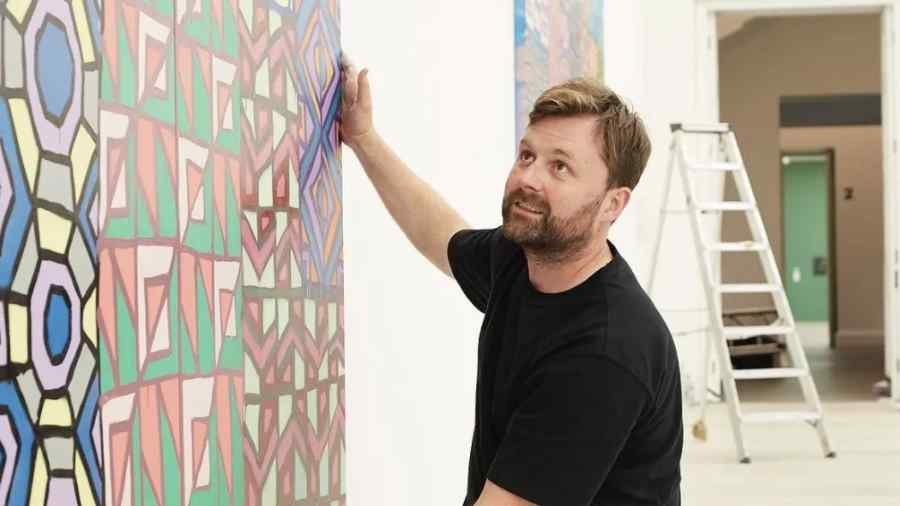
Dominic Beattie is a name that has steadily gained authority and recognition within the British contemporary art scene. Known for his bold engagement with abstraction, material experimentation, and a deep respect for Modernist traditions, Dominic Beattie occupies a space that feels both intellectually grounded and visually adventurous. His work does not merely decorate walls; it invites viewers into a dialogue about form, structure, colour, and the physicality of art itself.
Early Life and Artistic Foundations
Dominic Beattie was born in 1981 and grew up in the United Kingdom, where he developed an early interest in visual culture and making things by hand. From a young age, he showed a fascination with shapes, textures, and the way objects occupy space. This curiosity would later evolve into a disciplined artistic practice rooted in abstraction.
His formal training played a crucial role in shaping his artistic identity. He studied Fine Art Painting at Camberwell College of Arts, part of the University of the Arts London. This academic environment exposed him to a wide range of artistic influences, from early twentieth-century Modernism to post-war abstraction and contemporary experimental practices. During this period, Dominic Beattie began to refine his understanding of colour theory, composition, and material behaviour, laying the groundwork for his mature work.
Artistic Influences and Philosophical Approach
At the heart of Dominic Beattie’s work lies a strong engagement with Modernist ideals. He draws inspiration from artists and movements that prioritised form, structure, and material honesty over narrative or representation. Rather than telling stories in a conventional sense, his work communicates through rhythm, balance, and physical presence.
However, Dominic Beattie does not simply replicate Modernist aesthetics. He reinterprets them through a contemporary lens, allowing for imperfection, playfulness, and experimentation. His art reflects a belief that abstraction remains a powerful and relevant language, capable of expressing complex ideas without relying on literal imagery.
Another defining aspect of his philosophy is the importance of process. For Dominic Beattie, the act of making is as significant as the finished piece. Layers, textures, and construction methods are often visible, reminding viewers that the artwork is the result of physical labour and creative decision-making.
Materials, Techniques, and Mediums
One of the most compelling features of Dominic Beattie’s practice is his fearless use of materials. While painting remains central to his work, he frequently expands beyond the traditional canvas. Wood, metal, fabric, and found objects often feature in his pieces, blurring the boundaries between painting, sculpture, and design.
His paintings are known for their bold colour palettes and structured compositions. He often uses stencilling, layering, and collage techniques to build surfaces that feel dynamic and tactile. These methods create a sense of depth and movement, encouraging viewers to engage with the work both visually and physically.
In addition to painting, Dominic Beattie has produced sculptural works and furniture-like objects. These pieces challenge conventional definitions of fine art, inviting questions about function, form, and the relationship between art and everyday life.
Exhibitions and Public Recognition
Over the years, Dominic Beattie has exhibited extensively in the United Kingdom, particularly in London. His work has been shown in respected galleries and institutions, reflecting his established position within the contemporary art world. These exhibitions have allowed audiences to experience the full range of his practice, from intimate works on paper to large-scale installations.
Critical response to his exhibitions has often highlighted the confidence and clarity of his artistic vision. Reviewers frequently note his ability to balance intellectual rigour with visual impact, a combination that makes his work accessible without compromising depth.
Recognition through awards and prizes has further cemented his reputation. Such accolades not only acknowledge his technical skill but also his contribution to the ongoing conversation around abstraction in British art.
The Role of Colour and Geometry
Colour plays a central role in Dominic Beattie’s work. Rather than using colour purely for decorative purposes, he treats it as a structural element. His compositions often rely on carefully balanced colour relationships, creating tension and harmony within the frame.
Geometry is another key component of his visual language. Rectangles, grids, and repeated forms appear frequently, referencing architectural structures and design principles. These geometric elements provide a sense of order, which is often disrupted by irregular textures or unexpected material choices.
This interplay between control and spontaneity gives his work its distinctive energy. Viewers may initially be drawn in by bold colours and clear forms, only to discover subtle complexities upon closer inspection.
Dominic Beattie and Contemporary British Art
Within the broader context of contemporary British art, Dominic Beattie represents a continuation and evolution of abstraction. While figurative and conceptual art often dominate public discourse, his work demonstrates that abstraction remains a vital and expressive mode of artistic practice.
He occupies a space that bridges past and present, honouring the legacy of Modernism while embracing contemporary concerns and methods. This positioning allows his work to resonate with a diverse audience, from seasoned collectors to those encountering abstract art for the first time.
His commitment to material exploration and formal integrity also sets an example for emerging artists. In a time when digital tools and rapid production are increasingly common, Dominic Beattie’s hands-on approach serves as a reminder of the value of physical engagement with materials.
Collecting and Market Presence
Dominic Beattie’s work has attracted a growing base of collectors, both private and institutional. His pieces are valued not only for their aesthetic appeal but also for their conceptual strength and craftsmanship. Collectors often appreciate the consistency and seriousness of his practice, which suggests long-term relevance rather than fleeting trendiness.
The market presence of his work reflects a steady and sustainable trajectory. Rather than relying on hype, his reputation has been built through exhibitions, critical writing, and word-of-mouth within the art community. This measured growth contributes to his credibility and enduring appeal.
Personal Studio Practice and Daily Discipline
Behind the public exhibitions and finished artworks lies a disciplined studio practice. Dominic Beattie is known for his methodical approach to making, often working on multiple pieces simultaneously. This allows ideas to develop organically, with experiments in one work informing another.
His studio environment is an extension of his artistic philosophy. Materials are treated with respect, and the space itself becomes a site of exploration. This daily commitment to practice reinforces the depth and consistency evident in his body of work.
Cultural Impact and Lasting Significance
While abstraction can sometimes be perceived as detached or inaccessible, Dominic Beattie’s work challenges this assumption. His art engages viewers on a sensory level, encouraging emotional and physical responses alongside intellectual interpretation.
By maintaining a strong connection to materiality and form, he contributes to a broader understanding of what contemporary art can be. His work demonstrates that abstraction is not an outdated language but a flexible and evolving mode of expression.
Conclusion
Dominic Beattie stands as a compelling figure in British contemporary art, distinguished by his commitment to abstraction, material exploration, and thoughtful process. His work reflects a deep understanding of artistic history while remaining firmly rooted in the present. Through painting, sculpture, and experimental forms, he continues to expand the possibilities of abstract art.
As his career progresses, Dominic Beattie’s influence is likely to grow, inspiring both audiences and fellow artists. His practice serves as a reminder that meaningful art is often built through patience, discipline, and a genuine engagement with materials. In a rapidly changing cultural landscape, his work offers a sense of continuity, clarity, and enduring artistic value.