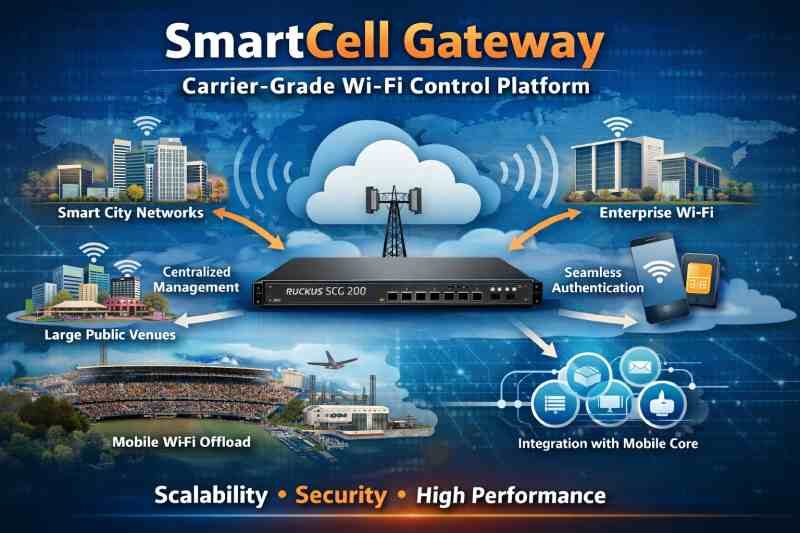
smartcell gatewaySmartCell Gateway is a carrier-grade Wi-Fi control and gateway platform designed to manage, secure, and scale very large wireless networks. Built for environments where reliability, performance, and seamless user experience matter, SmartCell Gateway has been widely used by mobile operators, service providers, and large enterprises that require tight integration between Wi-Fi and broader network infrastructure. Rather than being a simple wireless controller, it represents a more advanced approach to Wi-Fi, one that treats wireless access as a core network service rather than an add-on.
What Is SmartCell Gateway?
SmartCell Gateway is a high-capacity wireless LAN controller and gateway system designed to support massive numbers of access points and client devices. Unlike traditional enterprise controllers that focus mainly on office environments, SmartCell Gateway was engineered with service-provider scale in mind. This means it can handle tens of thousands of access points and hundreds of thousands of simultaneous users without compromising performance.
At its core, SmartCell Gateway centralises the intelligence of the Wi-Fi network. Access points deployed in the field rely on the gateway for configuration, authentication decisions, traffic handling policies, and monitoring. This approach simplifies network operations and ensures consistent behaviour across very large and geographically distributed deployments.
The Evolution of Carrier-Grade Wi-Fi
To understand the value of SmartCell Gateway, it is important to look at how Wi-Fi has evolved. Early Wi-Fi networks were small, localised, and relatively simple. As smartphones became widespread and mobile data demand surged, operators began using Wi-Fi as a way to offload traffic from cellular networks.
This shift created new requirements. Wi-Fi networks needed to integrate with mobile cores, support SIM-based authentication, and deliver service levels comparable to cellular networks. SmartCell Gateway emerged in response to these needs, offering a platform that could bridge the gap between Wi-Fi and mobile infrastructure while maintaining carrier-grade reliability.
Core Architecture of SmartCell Gateway
The architecture of SmartCell Gateway is designed around scalability, resilience, and centralised intelligence. It typically operates as a clustered system, allowing multiple gateway instances to work together. This clustering ensures high availability and load distribution, both of which are essential in large deployments.
Access points connect back to the SmartCell Gateway over secure tunnels. Once connected, they receive configuration profiles, firmware updates, and policy instructions. Client traffic can either be locally bridged or tunnelled through the gateway, depending on the deployment model and security requirements.
Centralised Control Plane
One of the defining characteristics of SmartCell Gateway is its centralised control plane. Network administrators define policies, authentication rules, and quality-of-service parameters in one place. These rules are then enforced consistently across the entire network.
This centralised approach reduces operational complexity and minimises configuration errors. It also makes it easier to roll out changes, such as new security policies or service offerings, without visiting individual sites.
Distributed Data Handling
While control is centralised, SmartCell Gateway supports flexible data handling. Traffic can be processed locally at the access point for low latency, or it can be tunnelled back to the gateway for deeper inspection and integration with core services. This flexibility allows operators to balance performance, security, and cost according to their specific needs.
Authentication and Security Capabilities
Security is a major focus of SmartCell Gateway. Large public and carrier networks face constant threats, ranging from unauthorised access to data interception. SmartCell Gateway addresses these challenges through robust authentication and encryption mechanisms.
It supports a wide range of authentication methods, including enterprise standards and carrier-oriented approaches. This allows both SIM-based devices and traditional Wi-Fi clients to connect securely using familiar credentials. Once authenticated, users are assigned policies that define what resources they can access and how their traffic is handled.
Policy-Driven Access Control
SmartCell Gateway uses policy-based management to control user behaviour. Policies can be defined based on user type, device category, location, or time of day. For example, a network can prioritise voice traffic during business hours or restrict bandwidth for guest users.
This level of control is essential in environments where many different user groups share the same infrastructure. By applying policies consistently, SmartCell Gateway helps maintain service quality for all users.
Scalability and Performance
One of the standout strengths of SmartCell Gateway is its ability to scale. Traditional controllers often struggle as networks grow, leading to performance bottlenecks and management challenges. SmartCell Gateway was designed from the outset to handle very large networks.
Its clustered architecture allows capacity to be increased by adding more gateway instances. Load is distributed automatically, ensuring that no single component becomes a point of failure. This design makes SmartCell Gateway suitable for city-wide Wi-Fi, transport systems, stadiums, and other high-density environments.
High Availability and Resilience
In carrier and public networks, downtime is not acceptable. SmartCell Gateway addresses this through redundancy and failover mechanisms. If one gateway instance fails, others in the cluster can take over its responsibilities with minimal disruption.
This resilience is critical for services that support emergency communications, public transport, or business-critical operations. Users may not even notice when a failover occurs, which is the hallmark of a well-designed carrier-grade system.
Integration with Broader Network Infrastructure
SmartCell Gateway was designed to fit into complex network ecosystems. It can integrate with existing authentication servers, billing systems, and monitoring tools. This makes it easier for operators to offer Wi-Fi as part of a broader service portfolio rather than as a standalone feature.
By aligning Wi-Fi management with existing network processes, SmartCell Gateway helps reduce operational silos. Operators can apply consistent policies across wired, wireless, and mobile networks, improving both efficiency and user experience.
Deployment Models and Use Cases
SmartCell Gateway has been deployed in a wide range of scenarios, each with its own requirements. Understanding these use cases helps illustrate the flexibility of the platform.
Mobile Operator Wi-Fi Offload
One of the most common use cases is Wi-Fi offload for mobile operators. In this scenario, SmartCell Gateway enables seamless authentication for subscribers and routes traffic in a way that reduces load on the cellular network. Users benefit from faster speeds and better indoor coverage, while operators save on spectrum costs.
Large Public Venues
Airports, stadiums, and convention centres often serve tens of thousands of users at once. SmartCell Gateway provides the scale and control needed to manage such environments. Operators can offer different service tiers, ensure fair bandwidth distribution, and monitor performance in real time.
Smart Cities and Municipal Networks
City-wide Wi-Fi initiatives require robust management and security. SmartCell Gateway supports these projects by providing centralised control across many locations. Municipalities can offer public internet access, support IoT services, and integrate Wi-Fi into broader smart city platforms.
Operational Management and Monitoring
Managing a large Wi-Fi network requires visibility. SmartCell Gateway includes monitoring and reporting features that give administrators insight into network performance, user behaviour, and potential issues.
By analysing this data, operators can identify congestion points, optimise access point placement, and improve overall service quality. Proactive monitoring also helps prevent outages by highlighting problems before they escalate.
Virtualisation and Modern Network Trends
As networks move towards virtualisation and cloud-based architectures, the principles behind SmartCell Gateway remain relevant. The platform introduced ideas such as centralised intelligence, scalable clustering, and policy-driven management that continue to influence modern Wi-Fi solutions.
Virtualised deployments allow operators to run gateway functions on standard hardware or in cloud environments. This approach reduces costs and increases flexibility while preserving the core benefits of the SmartCell Gateway design philosophy.
Advantages and Limitations
SmartCell Gateway offers many advantages, including scalability, security, and integration capabilities. It is particularly well suited to large, complex networks where traditional controllers fall short.
However, its carrier-grade design can be more complex than simpler enterprise solutions. Smaller organisations with limited requirements may find it more than they need. As with any network platform, careful planning is required to ensure that the benefits outweigh the operational overhead.
Frequently Asked Questions
What type of networks is SmartCell Gateway best suited for?
SmartCell Gateway is best suited for large-scale networks such as mobile operator Wi-Fi, public venues, municipal deployments, and extensive enterprise campuses.
Can SmartCell Gateway handle both public and private Wi-Fi users?
Yes, it can manage multiple user types simultaneously, applying different authentication methods and policies based on user roles and access levels.
Is SmartCell Gateway only for service providers?
While it was designed with service providers in mind, large enterprises with complex and high-density Wi-Fi needs have also successfully used SmartCell Gateway.
How does SmartCell Gateway improve Wi-Fi reliability?
It uses clustering, redundancy, and centralised control to minimise downtime and ensure consistent performance across the network.
Does SmartCell Gateway support future network upgrades?
Its scalable and modular design makes it adaptable to evolving network technologies, including virtualised and cloud-based environments.
Conclusion
SmartCell Gateway represents an important chapter in the development of carrier-grade Wi-Fi. By treating wireless access as a core network service, it set a standard for scalability, security, and integration that many modern platforms continue to follow. For organisations that need to deliver reliable, high-performance Wi-Fi to large and diverse user populations, the principles behind SmartCell Gateway remain highly relevant.