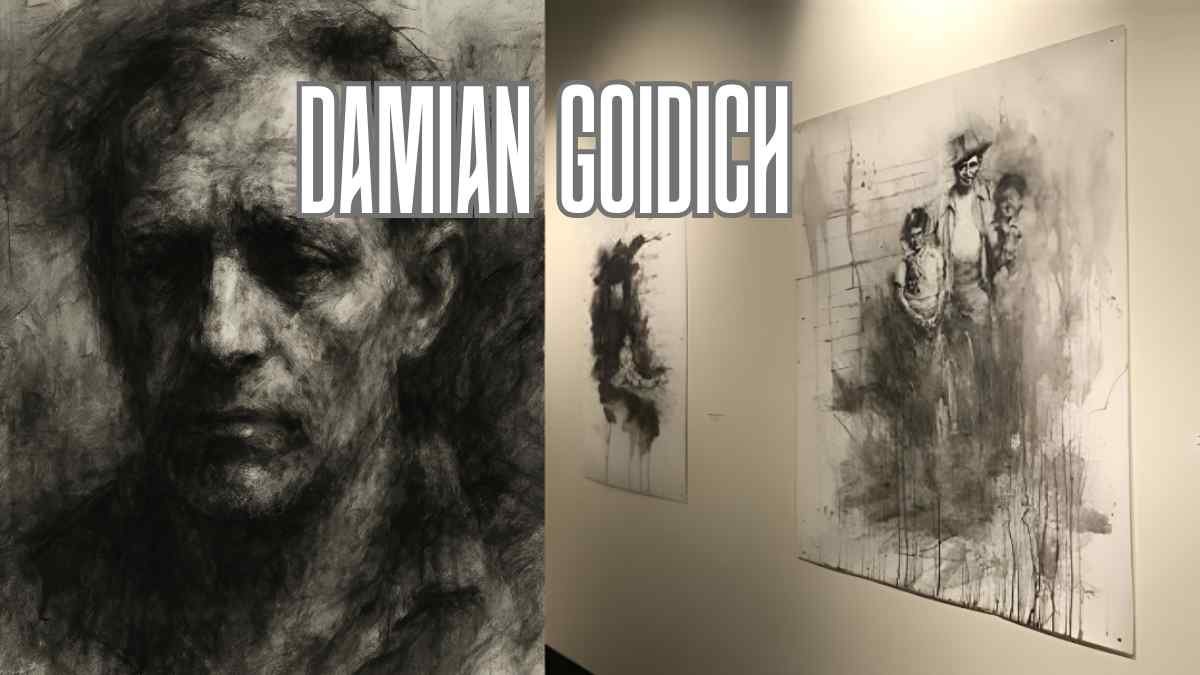
Damian Goidich stands as a striking example of a contemporary artist whose practice moves beyond mere visual representation and ventures into the subtle, often fragile realm of human memory. An American artist educated in the discipline of illustration and drawing, Goidich has developed an artistic voice that is both technically accomplished and deeply reflective. His work does not simply depict; it invites viewers to examine the very act of remembering—those fleeting moments when the mind grasps at an image, yet never fully captures its detail.
Early Life and Education
Damian Goidich’s formal training laid a strong foundation for his later explorations of memory and perception. He pursued a Bachelor of Fine Arts in Illustration and went on to complete a Master of Fine Arts in Drawing at the Kendall College of Art and Design, part of Ferris State University in Grand Rapids, Michigan. This dual grounding in illustration and fine art proved pivotal. Illustration gave him the discipline to master technical precision and an eye for detail, while the MFA encouraged him to challenge boundaries and to use drawing as a vehicle for conceptual and emotional investigation.
His education also immersed him in the wider traditions of drawing, where the hand’s direct mark on paper becomes a trace of thought. During these years, he refined a belief that drawing is not merely a preparatory stage for painting or sculpture but a powerful medium in its own right. Goidich has often highlighted that drawing provides a quiet intimacy; it is art at its most direct, where each mark reveals the artist’s movement and emotion in real time.
The Evolution from Illustration to Fine Art
After his academic years, Goidich initially worked as a freelance illustrator, particularly for educational materials. This experience honed his ability to communicate ideas clearly and to balance narrative with visual impact. Yet his deeper artistic instincts pulled him towards a more personal practice. Moving from commercial illustration into fine art allowed him to explore memory and emotion without the constraints of a client’s brief.
The shift was neither abrupt nor accidental. It mirrored his growing conviction that art should confront not only what we see but also how we remember. By stepping away from purely representational work, Goidich created space to investigate the hazy overlap between reality and recollection. This transition is visible in his early fine art exhibitions, where careful observation coexisted with smudges, erasures and the suggestion of images fading into the subconscious.
The Central Theme of Memory
Memory lies at the heart of Damian Goidich’s practice. Yet he does not attempt to reproduce memories as precise snapshots. Instead, he explores the nature of memory itself: its fluidity, its vulnerability to distortion, and the way emotions alter our recollections. In his drawings, certain forms are sharply rendered while others dissolve into blurred tones, mirroring the way the mind holds onto fragments and lets other details slip away.
This focus on memory also speaks to a broader human experience. We all live within the tension between the past we can recall and the past we have lost. Goidich captures that tension visually. Viewers are invited to engage not only with what they see but with what they cannot fully grasp. His art becomes a dialogue between the known and the half-remembered, between clarity and mystery.
Techniques and Materials
Charcoal is the medium with which Damian Goidich is most closely associated. He embraces its physicality—its dust, its richness of tone, and its capacity for both precision and spontaneity. Charcoal’s forgiving nature allows him to create deep blacks and soft greys, to draw and erase, to layer marks and then smudge them away. These acts of construction and erasure perfectly suit his exploration of memory, where recollections are formed, altered and sometimes lost altogether.
His process is deliberately dynamic. He may lay down bold, assertive lines only to obscure them later with veils of soft shading. At times he scrapes or wipes away pigment to leave ghostly remnants. This method of working mirrors the psychological process of remembering—moments emerge into focus, then fade, leaving traces that are both present and absent.
Goidich also experiments with scale. Some works are intimate, inviting close inspection; others are large, enveloping the viewer in a landscape of shadow and light. In every case, the tactile surface of the drawing reinforces the physicality of memory. His drawings are not static images but living records of thought and gesture.
Philosophical Underpinnings
Underlying Damian Goidich’s visual practice is a subtle but profound philosophy. He regards memory not as a fixed archive but as an active, creative process. We do not simply store the past; we reconstruct it each time we recall it. This understanding informs both the subject matter and the technique of his work.
In exploring how memories are shaped by emotion and by the passage of time, he touches on questions of identity. Who are we if our memories change? How do these shifting recollections influence our understanding of ourselves and of those we love? His art becomes a meditation on impermanence and the human need to hold onto the past even as it slips away.
This philosophical depth is matched by a sensitivity to the viewer’s own experience. Goidich does not dictate meaning. Instead, he invites each person to bring their own memories and emotions to the work. The drawings serve as a mirror in which viewers may glimpse their own histories and the bittersweet reality of remembering.
Exhibitions and Recognition
Damian Goidich’s commitment to exploring memory and drawing has earned him recognition in exhibitions and awards. He has presented solo and group shows that highlight the evolution of his practice over more than a decade. One notable exhibition titled “Now and Then” showcased works from different periods, allowing audiences to witness the development of his ideas and technique.
He has received prestigious awards such as the Ferris State University MFA Excellence in Art Purchase Award and recognition in regional arts competitions. These honours underscore the respect he commands within the artistic community and the impact his work has on viewers and critics alike.
Residencies have also played a role in his career. Opportunities such as the Golden Apple Art Residency have given him the space and time to delve deeper into his themes. Such residencies often provide not only creative freedom but also engagement with other artists, further enriching his practice.
Teaching and Mentorship
Alongside his personal practice, Goidich has contributed to the education of future artists. He has taught drawing, life drawing and painting at institutions such as Kendall College of Art and Design and Grand Rapids Community College. His dual perspective—as a practitioner deeply engaged in contemporary art and as a teacher—allows him to inspire students both technically and conceptually.
For his students, learning from someone who lives the tension between memory and representation offers a unique insight. He demonstrates that drawing is not simply about reproducing the visible world but about expressing the invisible processes of thought and emotion. His role as mentor ensures that his influence extends beyond his own works on paper to the next generation of artists.
Position within Contemporary Art
In the wider landscape of contemporary art, Damian Goidich occupies a distinctive position. While many artists explore memory, few do so with such direct reliance on drawing as their primary medium. At a time when digital art and multimedia installations often dominate galleries, his commitment to the traditional practice of drawing feels both classic and radical.
His work challenges the assumption that drawing is merely preparatory or secondary. By making drawing the heart of his exploration, he reclaims it as a powerful, self-sufficient art form capable of addressing profound philosophical questions. This positioning gives his practice both timelessness and contemporary relevance.
Conclusion
Damian Goidich exemplifies how an artist can transform a simple medium into a profound exploration of human experience. Through charcoal drawings that blur the boundary between presence and absence, he examines the very nature of memory—its fragility, its distortions and its emotional power. From his early training in illustration to his mature practice as a fine artist and teacher, his journey illustrates the potential of drawing to speak to our deepest need to remember and to make sense of the past. In an age of fleeting digital images, his work reminds us that the act of making marks by hand remains one of the most potent ways to explore who we are and how we recall the world we have lived.