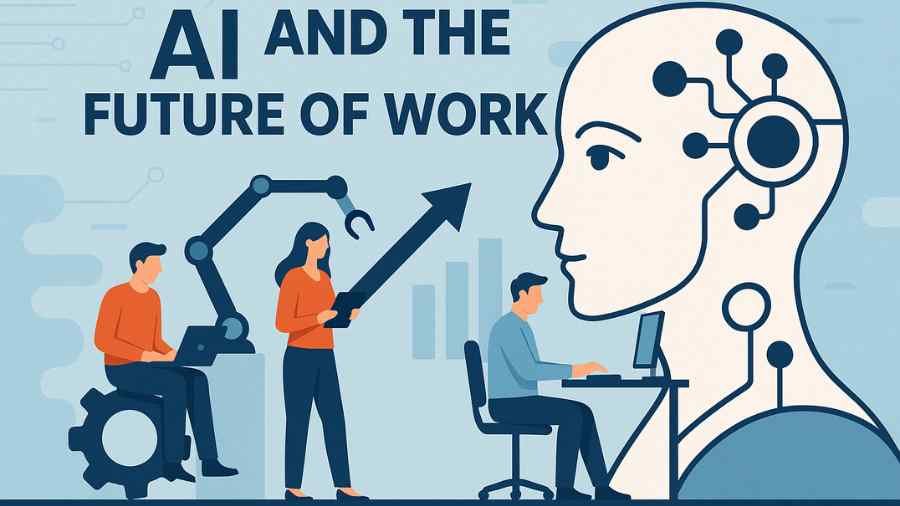
It was in 1951 at the University of Manchester when the first artificially intelligent algorithm was developed by Christopher Strachey. It was a checkers-playing program and since then, these AI algorithms have come a long way.
Now, we have AI-powered vacuum cleaners cleaning our floors without much human intervention. AI has found its way into almost every industry that you can possibly think of. From construction to recruitment, AI is everywhere, because of its ability to enhance existing technology by making it efficient.
Speaking of efficiency, AI is playing its part in making the workforce and workflows more efficient and effective. However, an air of skepticism is looming around because of the displacement it can cause in the job market. Is it true? I think that’s not true in the black and white sense because there are some positives around that too.
So, join me as I unfold the future of work in which AI plays a significant part.
AI’s Influence on Job Roles
I was looking at the jobs the other day, and multiple companies have marked the use of AI as a required skill for the job. It’s an undeniable fact that AI has had a great influence on job roles. This is how AI is further affecting the jobs:
- Automation of Routine Tasks: The roles that don’t involve creativity are greatly helped by integrating AI within the workflows. For example, sending emails to a massive list of prospects can be automated using AI. This improves the overall efficiency of the work and reduces the overall cost.
- Emergence of New Professions: The tech giants have poured billions of dollars into AI innovation, which has resulted in the creation of more jobs that are directly or indirectly related to AI. Machine learning engineers, promptengineers, program testers, and more. Though there has been displacement, AI has created jobs as well.
- Transformation of Existing Roles: Since it makes our lives easier, more organizations tend to use AI, and I have seen them tweaking their job descriptions. For example, it used to be a simple Content Writer job, but now organizations want AI-powered Content Writers.
Workforce Trends Shaped by AI
Since AI has found its way into almost every sector, it is changing the workforce trends quite significantly.
- Shift Towards Remote Work: Though COVID has played its part in making remote work a top choice for companies, AI has its share in it too. Organizations now have access to reliable software that helps the employees and the companies. For example, when I am working from home using my high-speed Optimum Internet, I can use AI-powered softwarethrough the cloud reliably to track my performance,which also provides me with the necessary steps to improve it.
- Increased Demand for Tech Skills: Since AI has made it to the headlines, a lot of businesses want talent that is familiar with using AI tools. This helps the employees and reduces turnaround time for businesses because of the efficiency unlocked by them. If you are not familiar with such tools, then you should start with the foundational understanding of prompt engineering, and then build up your digital literacy from there.
- Rise of the Gig Economy: AI has reduced the workforce needed to do certain jobs. So, instead of relying on full-time employees, more businesses are leaning towards freelancers and contractors. This saves them time and money. I was talking to a recruiter and they told me how big their budget is for recruiting the right talent.
Case Studies on AI’s Influence on Work
Let’s take a look at some real-life examples of companies using the power of AI for various work activities.
AI in the Recruitment Process
- Unilever: The company implemented an AI-powered virtual interviewing tool to analyze candidates’ responses and facial expressions. This increased the speed of the hiring process and improved candidate selection.
- Vodafone: By integrating AI into its recruitment process, Vodafone reduced hiring time by 50% and saw a higher job acceptance rate.
Automation in Banking
- JPMorgan Chase: The bank introduced an AI tool to assist employees with preparing briefing materials and processing legal documents, boosting productivity and efficiency.
- Commonwealth Bank of Australia: AI is used to automate responses to thousands of daily inquiries and improve fraud detection, reducing reliance on call center staff.
AI-Driven Content Creation
- The Washington Post: The publication developed an AI tool that generates articles for routine news coverage, allowing journalists to focus on more complex stories.
- Forbes: The media company uses AI to assist in content creation by generating first drafts and analyzing trends, enhancing productivity and personalization.
Challenges and Ethical Considerations
While AI can bring a lot to the table in the job market, it has its own set of challenges. These include:
- Job Displacement Concerns: AI can indeed displace some parts of our jobs, but those tasks are repetitive or mediocre. Only the average worker is going to be replaced by AI. However, it is also producing more jobs. For example, some businesses need prompt engineers to create keybooks of prompts that will help businesses or individuals make their work more efficient.
- Bias and Fairness in AI: The problem I see with AI is that it is trained on a certain data set. Based on what that data set feeds the AI, it is going to produce outputs according to that. Essentially, there is a risk of bias or unfairness. Humans can think but AI won’t, so unfairness and biasing are possible.
- Privacy Issues: Since the systems will be surrounded by these AI tools, there is a serious concern about privacy. Again, AI can’t think and it can collect data that it shouldn’t,which is why it is an issue that needs to be addressed.
Preparing for an AI-Integrated Workforce
The concerns with AI in the workforce can be addressed using some of these ways:
- Educational Reforms: AI is already there and it is we who should prepare ourselves for the best. And what better way from the ground up? Educational plans should include the ethical way of using AI to speed up the work and make it better.
- Lifelong Learning and Upskilling: It won’t be an exaggeration if I say that AI has disrupted the job market. To stay ahead of the curve, you need to adopt an attitude of lifelong learning. This, not only will help you adapt to AI, but anything that is yet to come.
Frequently Asked Questions (FAQs)
What are the biggest benefits of AI in the workplace?
AI can take over repetitive tasks, boost productivity, and helpbusinesses make smarter decisions. It also improves customer service, speeds up hiring, and reduces errors, making work more efficient overall.
Can AI help reduce hiring biases?
Yes, it can. AI evaluates candidates based on skills instead of gut feelings. But if the data it’s trained on has biases, they can slowly creep in. That’s why companies need to fine-tune AI systems to keep hiring fair.
Which tasks are most likely to be automated by AI?
Tasks that are repetitive and data-heavy,such as data entry, chatbots handling customer support, and fraud detection, are more likely to be automated using AI. However creative and decision-making roles still need a human touch.
Can AI be creative? How is it affecting content creation and design jobs?
AI can generate text, music, and designs, but it lacks real creativity. It’s more of a tool that speeds up work, giving writers and designers a head start rather than replacing them.