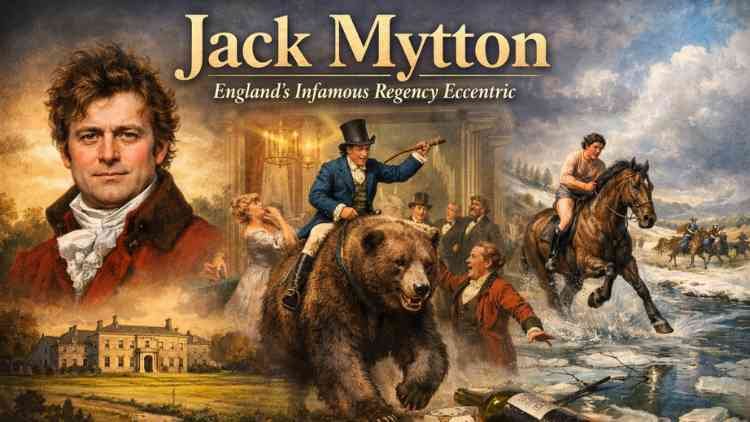
Jack Mytton remains one of the most fascinating and controversial figures of early nineteenth-century England. Known equally for his wealth, recklessness, charm, and self-destruction, he has endured in British history as a symbol of unchecked privilege and excess. Living during the Regency period, a time associated with elegance, refinement, and social change, Jack Mytton stood apart as a man who rejected restraint and convention at every turn. His life story is not merely one of scandal and spectacle, but also a revealing portrait of the social, political, and moral landscape of his era.
Often remembered by the nickname “Mad Jack,” Mytton’s reputation was built on daring exploits, extravagant spending, outrageous humour, and a persistent disregard for personal safety and social norms. Yet beneath the legends lies a complex individual shaped by inheritance, expectation, and a society that struggled to rein in the behaviour of its privileged elite.
Early Life and Family Background
Jack Mytton was born in September 1796 into a wealthy and long-established Shropshire family. His full name was John Mytton, and he inherited not only significant land and income but also a powerful sense of entitlement from birth. The Mytton family owned large estates, and young Jack grew up surrounded by privilege, servants, horses, and hunting grounds.
From an early age, it became clear that he possessed an unruly temperament. Tutors struggled to discipline him, and his impulsive nature often led to confrontations. Despite being sent to prestigious schools, he showed little interest in academic study or personal improvement. Discipline and routine, central to elite education at the time, were entirely at odds with his personality.
Jack Mytton’s upbringing highlights an important reality of Regency England: wealth and lineage often shielded young men from the consequences of misbehaviour. This lack of early restraint would later shape the course of his adult life.
Education and Early Signs of Rebellion
Jack Mytton was educated at some of England’s most respected institutions, yet he failed to settle at any of them. He was dismissed from schools due to persistent misconduct, practical jokes, and defiance of authority. His brief time at university followed the same pattern. Rather than focusing on lectures or scholarly pursuits, he immersed himself in drinking, gambling, and social excess.
These years are important in understanding his later behaviour. Rather than curbing his recklessness, education only provided him with new environments in which to express it. He developed a taste for public spectacle and gained a reputation for daring acts that bordered on self-harm.
Even in his youth, Jack Mytton appeared driven by a desire to test limits, whether physical, social, or moral. This quality would later make him both infamous and strangely admired.
Wealth, Inheritance, and Sudden Independence
The turning point in Jack Mytton’s life came with the inheritance of his estate and fortune while still a young man. Overnight, he gained control of enormous wealth, extensive lands, and a substantial annual income. With no effective supervision and no real sense of responsibility, he began spending at an astonishing rate.
Rather than investing in land management or social advancement, he devoted his fortune to horses, hunting, drinking, and gambling. His stables became legendary, housing some of the finest horses in the country. He was known to purchase animals without concern for cost, sometimes paying more than sensible market value simply to satisfy a whim.
This period represents the height of Jack Mytton’s power and influence. He was wealthy enough to ignore criticism, bold enough to defy convention, and young enough to believe his fortune was inexhaustible.
Obsession with Hunting and Risk
Hunting was central to Jack Mytton’s identity. He was a fearless rider, renowned for taking extraordinary risks across dangerous terrain. He hunted in extreme weather, rode at reckless speed, and appeared to treat danger as a form of entertainment.
Stories from the period describe him riding across frozen lakes, leaping fences others avoided, and challenging fellow riders to follow him into near-certain peril. His bravery was genuine, but it was inseparable from recklessness. Injuries were frequent, yet he treated them lightly, returning to the saddle as soon as possible.
In Regency society, hunting symbolised masculinity, status, and courage. Jack Mytton embodied these ideals to an extreme degree, pushing them far beyond what most considered sensible or admirable.
Social Life and Notorious Behaviour
Jack Mytton’s social reputation was built on his unpredictable behaviour. He was known for elaborate practical jokes, excessive drinking, and outrageous stunts that shocked even his fellow aristocrats. Dinner parties, country gatherings, and social events often became stages for his antics.
While some found his behaviour entertaining, others viewed it as deeply troubling. His humour frequently crossed into cruelty, and his disregard for safety extended to those around him. Despite this, his charm and status ensured he remained welcome in many social circles, at least initially.
This tolerance reflects the contradictions of Regency society, which often excused excess among the wealthy while condemning similar behaviour among the poor.
Political Ambition and Brief Parliamentary Career
At one point, Jack Mytton attempted to enter politics, securing a seat in Parliament. His political career, however, was remarkably short-lived. Lacking interest in debate, legislation, or public service, he quickly grew bored.
Accounts suggest that he found parliamentary life tedious and ill-suited to his temperament. After a single appearance, he effectively abandoned politics, having already spent a significant sum to secure the position.
This episode illustrates both the ease with which wealth could purchase power and the limits of such power when unaccompanied by discipline or purpose.
Financial Decline and Mounting Debt
Despite his vast inheritance, Jack Mytton’s spending soon outpaced his income. Gambling losses, extravagant purchases, and generous hospitality drained his resources. Over time, estates were mortgaged, land was sold, and debts accumulated.
Unlike many landowners who adapted to financial pressure, Mytton continued living as though his fortune remained intact. Denial played a major role in his downfall. He refused to change his lifestyle or accept responsibility for his finances.
By his early thirties, the once-wealthy squire was deeply in debt, pursued by creditors, and increasingly isolated from respectable society.
Exile, Imprisonment, and Final Years
In an attempt to escape his creditors, Jack Mytton fled abroad, spending time on the continent. However, exile did little to improve his circumstances. Without income and unable to restrain his habits, his situation worsened.
Eventually, he returned to England, where he was imprisoned for debt. His final years were marked by illness, poverty, and mental decline. The man once celebrated for fearless riding and extravagant living died in confinement, a stark contrast to his earlier life of privilege.
He passed away in 1834 at the age of thirty-seven, a tragic end to a life lived at full intensity but without moderation.
Myth, Memory, and Historical Reputation
Jack Mytton’s story has been retold countless times, often embellished with exaggeration and folklore. Some tales are undoubtedly apocryphal, yet they reflect how his contemporaries viewed him: as a man larger than life, both fascinating and alarming.
Historians today see him not merely as a reckless eccentric but as a product of his social environment. His life exposes the dangers of inherited privilege without accountability and the social structures that enabled excess.
At the same time, his fearlessness and individuality continue to inspire curiosity. He represents a cautionary tale, but also a reminder of a period when personal freedom among the elite was virtually unchecked.
Cultural Legacy in Modern Britain
Jack Mytton’s name remains embedded in British cultural memory, particularly in Shropshire. Trails, local stories, and regional history continue to reference his exploits. Writers and historians frequently revisit his life as an example of Regency eccentricity.
His legacy endures not because he achieved greatness, but because he lived without compromise, for better and worse. In an age increasingly defined by regulation and restraint, his story offers a glimpse into a wilder, more dangerous version of aristocratic life.
Conclusion
Jack Mytton’s life was extraordinary not for its achievements, but for its intensity. He rose swiftly on the advantages of birth and fortune, lived boldly and recklessly, and fell just as dramatically. His story captures the excesses of Regency England and the personal cost of unchecked freedom.
More than a curiosity, Jack Mytton stands as a historical lesson in the balance between privilege and responsibility. His legacy endures as both entertainment and warning, ensuring that his name continues to fascinate readers seeking to understand the human extremes of Britain’s past.