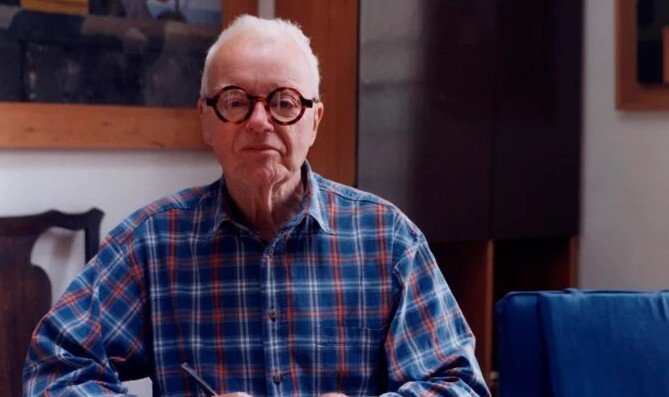
Kenneth Rowntree remains one of the most thoughtful and understated figures in twentieth-century British art. While never a self-promoter or headline-seeking personality, his influence can be traced across painting, mural art, illustration, and art education. His career unfolded during periods of enormous cultural change, from pre-war Britain through post-war reconstruction and into the modern era. Throughout these decades, Rowntree maintained a distinctive visual language that balanced observation, imagination, and a quietly modern sensibility.
Early Life and Background
Kenneth Rowntree was born in 1915 in Scarborough, Yorkshire, a coastal town whose changing skies and expansive landscapes would leave a lasting impression on his visual imagination. Growing up in northern England, he developed an early sensitivity to place, structure, and atmosphere. These elements later became central to his work, whether he was painting rural scenes, architectural spaces, or large-scale murals.
From an early age, Rowntree demonstrated a strong inclination towards drawing and design. Unlike artists driven by flamboyance or rebellion, his creative instincts leaned towards careful observation and thoughtful interpretation. This temperament shaped the steady, reflective quality that would define his career.
Artistic Education and Formative Influences
Rowntree pursued formal training at two of Britain’s most respected institutions: the Ruskin School of Art in Oxford and later the Slade School of Fine Art in London. At the Slade, he encountered a rigorous approach to drawing and composition, alongside peers who would later become prominent figures in British art.
During this period, Rowntree absorbed influences from European modernism while remaining grounded in British traditions of landscape and topographical painting. Rather than fully embracing abstraction, he developed a hybrid style that allowed structure and form to coexist with expressive freedom. This balance would become one of his defining strengths.
The Great Bardfield Connection
A significant chapter in Rowntree’s life was his association with the Great Bardfield Artists, a loosely connected group based in Essex. This community included painters, illustrators, and designers who shared ideas while maintaining individual styles.
The Great Bardfield ethos valued craftsmanship, accessibility, and everyday subject matter. For Rowntree, this environment reinforced the belief that art could be intellectually serious without becoming detached from ordinary life. His work from this period reflects both camaraderie and independence, capturing scenes that feel lived-in rather than staged.
War Years and the Recording of Britain
The Second World War marked a turning point in Rowntree’s career. Like many artists of his generation, he was commissioned to contribute to projects that documented Britain during wartime. His work from this era often depicts towns, industrial settings, and landscapes shaped by both history and impending change.
Rather than dramatic battle scenes, Rowntree focused on the quieter realities of wartime Britain. His paintings and drawings recorded buildings, streets, and rural spaces with a sense of urgency tempered by restraint. These works now serve as valuable visual records of a country in transition.
Post-War Artistic Development
After the war, Rowntree’s art evolved in response to a nation rebuilding itself. His colour palette became more adventurous, and his compositions more dynamic. He explored both figurative and abstract tendencies, often blending the two in ways that felt natural rather than forced.
During this period, Rowntree produced paintings that examined urban growth, industrial landscapes, and the rhythms of modern life. His approach was never harsh or cynical; instead, he conveyed complexity through layered forms and subtle shifts in tone. This ability to capture change without sensationalism set him apart from many contemporaries.
Mastery of Mural Painting
One of Kenneth Rowntree’s most significant contributions to British art was his work as a muralist. Mural painting requires a unique blend of technical skill, spatial awareness, and narrative clarity, and Rowntree excelled in all three.
His murals were not merely decorative. They engaged with their architectural settings and invited viewers to consider history, movement, and human activity on a larger scale. His involvement in major national projects, including work associated with mid-century public celebrations, demonstrated the trust placed in his vision.
Rowntree also played a key role in reviving mural painting as a respected discipline in Britain, at a time when it risked being overshadowed by easel painting and commercial design.
Teaching and Academic Influence
Beyond his own artistic output, Rowntree’s legacy is deeply tied to his role as an educator. He taught at the Royal College of Art and later became Professor of Fine Art at Newcastle, where he influenced generations of artists.
As a teacher, Rowntree was known for his calm authority and encouragement of independent thinking. He did not impose a single style or ideology, instead urging students to develop personal responses to materials, space, and subject matter. His leadership helped establish mural painting and large-scale work as serious academic disciplines.
Many of his students went on to successful careers, carrying forward his belief in thoughtful experimentation grounded in solid craftsmanship.
Illustration and Design Work
While painting and murals form the core of his reputation, Rowntree was also an accomplished illustrator and designer. He contributed illustrations to books and publications, applying the same sensitivity to line and composition found in his paintings.
His illustrative work reveals a playful side, often infused with wit and gentle humour. These qualities made his designs approachable without sacrificing depth, and they demonstrate his versatility across different media.
Artistic Style and Visual Language
Kenneth Rowntree’s style resists simple categorisation. He moved comfortably between representation and abstraction, often within a single work. Architectural forms, landscapes, and human activity are recurring motifs, rendered with an emphasis on structure and rhythm.
His use of colour was expressive but controlled, favouring harmony over shock value. Lines and shapes interact in ways that suggest movement and continuity, inviting viewers to linger and explore rather than consume quickly.
This measured approach has contributed to the enduring relevance of his work, which continues to feel thoughtful rather than dated.
Recognition and Exhibitions
Although never a household name, Rowntree received significant recognition during his lifetime and beyond. His work has been exhibited in major galleries and included in important public collections. Retrospectives and centenary exhibitions have helped reintroduce his work to new audiences, highlighting the breadth and consistency of his career.
Critics often note the quiet confidence of his art, praising its intelligence and emotional restraint. In an age increasingly drawn to spectacle, Rowntree’s work offers an alternative model of artistic success based on integrity and depth.
Personal Character and Working Philosophy
Rowntree was known among peers and students as modest, reflective, and deeply committed to his craft. He valued sustained effort over rapid acclaim and believed that art should grow out of lived experience and careful thought.
This philosophy is evident in the longevity of his career and the coherence of his body of work. Rather than chasing trends, he allowed his style to evolve naturally, responding to new ideas without abandoning core principles.
Lasting Impact on British Art
Kenneth Rowntree’s influence extends beyond individual paintings or murals. He represents a generation of artists who bridged tradition and modernity without dramatic rupture. His career demonstrates that innovation can be subtle, and that public art can be both accessible and intellectually rich.
Today, his work continues to resonate with artists, historians, and collectors who value craftsmanship, clarity, and quiet experimentation. In a cultural landscape often dominated by extremes, Rowntree’s balanced approach feels increasingly relevant.
Conclusion
Kenneth Rowntree stands as a reminder that artistic importance is not always measured by fame or controversy. Through decades of painting, mural work, teaching, and illustration, he contributed steadily to the fabric of British art. His legacy lies in the depth of his observation, the generosity of his teaching, and the enduring quality of his work. For those willing to look closely, his art offers insight, warmth, and a profound respect for both place and people.