Machar Stones: Ancient Monoliths of Stirling – A Deep Dive into Their History, Mystery and Significance

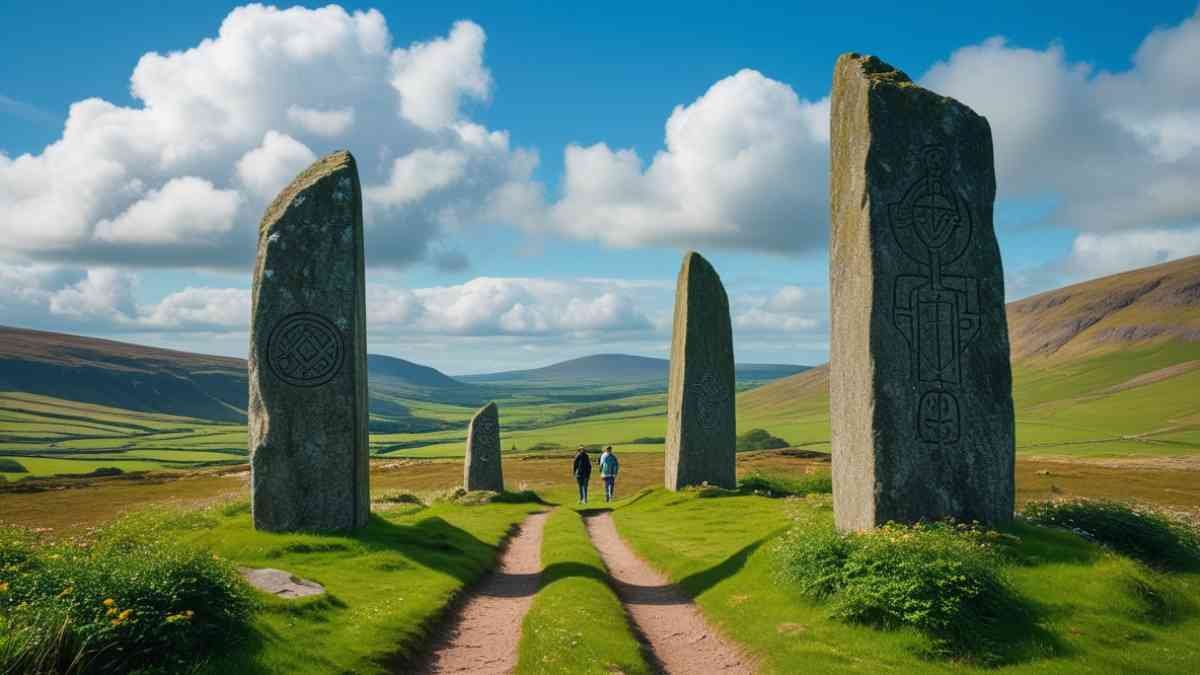
The Machar Stones are among Scotland’s lesser-known but profoundly evocative megalithic monuments. Situated in the parish of Fintry, Stirlingshire, these two standing stones—also known as the Waterhead Stones—command attention not by their size or fame but by their mystery, setting, and the insight they offer into prehistoric ritual, landscape, and belief.
What and Where are the Machar Stones
The Machar Stones are a pair of standing stones located roughly half a mile east-northeast of Waterhead Farm, in Stirlingshire. Their grid reference is given as NS 65705 83932. They sit on a slight hillock or rise in moorland now partially taken over by forestry. The stones are also known locally as the Waterhead Stones. In older sources, the area is referred to simply by its parish, “Fintry,” but with names such as “Machar” reflecting Gaelic origins.
Physical Description
Dimensions and Orientation
The northerly stone is irregular in cross-section (roughly rectangular), measuring about seven feet six inches (around 2.29 metres) in length when nearly prostrate. At its widest mid-section it is approximately three feet by two feet six inches. The southerly stone, standing upright, or at least more upright, is about five feet high (around 1.52 metres), with a thickness about two feet. Its width varies: at ground level roughly two feet eight inches, at a point two feet up about three feet eight inches, narrowing towards the top to about two feet. The two stones stand approximately 1.8 metres apart, and are aligned roughly in a north-north-east to south-south-west direction.
Setting and Surroundings
They are set on a small raised mound in what was historically open moor, though conifer plantations have since enclosed some of the view. The platform on which the stones appear may be artificial or enhanced. The earth around the stones shows a distinct oval depression, suggesting past disturbance or excavation, possibly associated with ritual or burial structure nearby. One stone, the leaning or prostrate northerly one, carries cup-marks on its underside—seven in total, the largest being about two centimetres across and about one centimetre deep.
Archaeological History and Interpretation
Dating and Origins
No firm radiocarbon date has been assigned directly to the Machar Stones themselves. The suggestion is that they may be prehistoric—Neolithic or early Bronze Age—given their form and comparisons with other standing stones in Scotland. Early antiquarian sources in the nineteenth century described them as “druidical remains,” hinting at pre-Christian ritual uses. However, much of that is speculation rather than based on excavation data.
Archaeological Records and Surveys
They were surveyed by the Ordnance Survey and recorded in multiple archaeological inventories. A Royal Commission on the Ancient and Historical Monuments of Scotland report from 1963 gives measurements and details, including reference to loose stones around the bases. The stones have been scheduled as an officially protected site in Scotland.
Function and Purpose
The exact purpose is unknown. Some of the hypotheses include markers for ritual or spiritual activity, perhaps tied to sunrise or seasonal solar phenomena. Early descriptions suggest that the alignment from stone to stone is roughly towards the quarter of sunrise at summer solstice, but later surveys have not confirmed any precise astronomical alignment. A possible connection with burial has been considered: the oval depression around the stones suggests prior ground disturbance; nearby prehistoric tombs or cists are common in similar landscapes. However, no confirmed buried human remains have been tied to the Machar Stones themselves by recent excavation that is publicly documented.
Etymology and Folklore
The name “Machar” is derived from Gaelic magh, meaning “plain” or “field”, sometimes “low-lying ground”. Some commentators note that while the literal meaning might not reflect the current topography, since the stones are on a rise, naming can often occur relative to higher surrounding land. Early writers, such as in Smith’s Strathendrick and its Inhabitants (1896), refer to local tradition that the Machar Stones were associated with religious worship of prehistoric inhabitants of the land. Folklore around the Machar Stones is not as rich or popular as with some of Scotland’s more famous megaliths, perhaps because they are obscure and somewhat difficult to access. Yet their remote character and their quiet majesty invite speculation and local storytelling—even if such stories are not well documented.
Landscape, Visibility and Visitor Notes
Landscape Position
These stones were originally placed in open moorland, likely to have extensive views, including to the rivers Bin Burn and River Carron nearby. The rising ground between the Kilsyth Hills, particularly Meikle Bin, may have been significant in their placement—for example in terms of sightlines for sunrise or landscape features. Over time, plantation forestry has encroached, reducing visibility and altering the feel of the landscape. What might once have been a dramatic open viewpoint is now more enclosed by trees.
Access
Getting to Machar Stones is not straightforward. There are no major roads that lead directly to the site. Walkers must follow forest tracks and perhaps make their way through less maintained woodland or moorland. The journey involves careful navigation, especially because some directions are vague, paths over moorland can be boggy, and the stones are not well signed. The site lies within forestry plantations in parts, so undergrowth and trees may obscure the stones or paths, especially in seasons of leaf growth.
Preservation
As with many megalithic sites, preservation depends on maintaining the land around them—keeping vegetation under control, preventing damage by forestry operations, and curbing erosion. Being scheduled protects them under law, but natural decay and human interference remain risks.
Scholarly Debate and Speculation
There remain points of debate among archaeologists, historians and enthusiasts. Early observers claimed an alignment toward the summer solstice sunrise; others speculate the line between the stones points north-north-east to south-south-west. Recent evidence does not confirm strong precision in astronomical alignment. Some of the puzzling variations may be due to tree cover, shifting of stones, or measurement error. Some believe the stones are placed on a raised platform, or that the rise is artificially enhanced, which might suggest importance in how the stones were presented or viewed. Others argue that the hillock is natural. While neighbouring sites often accompany burial practices, no definitive evidence of a tomb integrated with the Machar Stones has yet been published aside from inferences via the surrounding depression. The cup-marks may indicate ritual marking.
Why the Machar Stones Matter
These stones are not grand in comparison to some of the more famous stone circles or standing stones, but they are valuable for several reasons. They lie in a landscape rich in prehistoric remains. Sites like this help us understand how early communities marked, used, and understood the land. Even obscure sites contribute to the broader picture of ritual behaviour, seasonal observance, and monument building in prehistoric Britain. Because they are less visited, these stones are an opportunity for low-impact tourism, local interpretation, and heritage engagement without overwhelming infrastructure. Their condition, the encroachment of forestry, and the obscured views make them a good example of heritage under environmental pressures—not just vandalism but natural overgrowth and land management.
How Machar Stones Compare with Other Ancient Sites
Larger stone circles like those at Callanish, Machrie Moor, or Avebury attract more attention, have often been dug, have many stones, and are sometimes aligned in multiple directions. Machar Stones are simpler: just two stones, one leaning, one upright. Many megalithic sites show alignments—either with solstices, equinoxes or prominent landscape features. Machar Stones possibly share this tendency but with less confidence. Many stone arrangements include burial cairns or cists (stone boxes for bodies or ashes). While parts of Scotland have these, for Machar Stones direct evidence of burial is lacking. Sites closer to settlements tend to be better known, easier to visit, and to attract more research. Machar Stones’ obscurity and partial tree cover make them harder to see and less studied, which increases the mystery but limits data.
Challenges in Research and Interpretation
Limited excavation means no major modern archaeological dig has been published that fully explores the Machar Stones in recent years. This limits dating, stratigraphic evidence, or organic remains for radiocarbon dating. Trees planted since the early twentieth century have changed the setting, visibility, and perhaps even soil conditions around the stones. Weather, root growth, human interference or even livestock can shift stones or damage the ground around them. Cup-marks and small scale carvings or features are inherently fragile. Because the Machar Stones are less well known, there is less public pressure and fewer resources for research, visitor infrastructure, signage, or preservation compared to more famous sites.
Suggestions for Future Study
Detailed surveying with high-resolution mapping of the site, including laser scanning to map the terrain, ground depressions, and potentially locate associated features underground, would be valuable. Small targeted trenches around the stones could test for buried features such as cist remains, post holes, human bone, or charcoal for dating. Investigation of whether the platform or rise is natural or enhanced, with soil composition studies to find evidence of human reworking, could clarify the setting. Archaeoastronomy work could provide clearer measurements of alignment toward solar or lunar events, using modern tools. Better interpretation for visitors, signage to help locate the site, and perhaps trails that minimise damage while making the stones more accessible would also help. Comparing the Machar Stones with similar stone pairs in Scotland and beyond would show patterns in size, alignment, spacing, and associated features.
Conclusion
The Machar Stones may not be the largest or most famous monuments in Scotland, but their charm lies precisely in their mystery and subtlety. With two stones standing, aligned over a rise, bearing cup-marks, set in a landscape of rivers and hills, they embody a rich prehistoric sensibility to place and ritual. What they definitively are is reminders of human beings in deep prehistory who sought to mark out space, perhaps observe the skies, engage with the land, memorialise the dead, or conduct spiritual rituals. What they might be—but which remains to be proven—is a site of ceremony, observatory or even burial. For anyone interested in ancient Scotland, ritual landscapes, or the way our ancestors related to the natural world, Machar Stones are a compelling site. They pose questions more than provide answers—but perhaps that is part of their power.