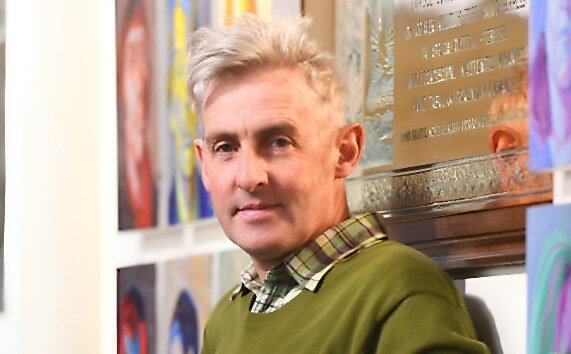
Mark Cazalet is one of Britain’s most distinctive contemporary artists, celebrated for his mastery of colour, texture, and spirituality in visual form. His career spans painting, drawing, printmaking, and large-scale public art commissions, including stained glass, mosaics, and murals found in some of the UK’s most historic cathedrals. Born in London in 1964, Cazalet has spent decades exploring how art can express both the sacred and the sensory—how light, faith, and environment intertwine to form visual narratives that transcend language.
Early Life and Education
Mark Cazalet’s journey into art began at a young age in the heart of London’s vibrant cultural scene. He trained at Chelsea School of Art between 1982 and 1983, and then at Falmouth School of Art from 1983 to 1986. His studies were marked by an early fascination with how light interacts with space—a theme that would dominate his later works.
He continued his artistic development through prestigious postgraduate scholarships, including time at the École des Beaux-Arts in Paris, under the mentorship of Christian Boltanski, and later at the M.S. University in Baroda, India. This international exposure deeply influenced his aesthetic sensibility, merging European precision with Indian spiritual vibrancy.
Artistic Philosophy and Vision
At the core of Mark Cazalet’s art is a quest to depict light not merely as a visual element but as a spiritual metaphor. His works capture the fleeting, almost mystical transitions between day and night, dusk and dawn, representing moments of revelation and transformation. He sees art as a means of contemplation—an exploration of faith, time, and the human condition through colour and texture.
Cazalet once remarked that every person possesses a unique creative voice, and his mission as both artist and educator has been to help others discover it. His teaching philosophy reflects his belief that creativity is not confined to talent but emerges through curiosity, reflection, and experimentation.
The Mediums of Expression
Unlike many contemporary artists who specialise in a single medium, Mark Cazalet thrives on diversity. He moves fluidly between painting, printmaking, and large-scale installations, embracing the physicality and tactile nature of art.
His paintings are characterised by rich layers of pigment, vibrant hues, and textured surfaces that evoke emotion as much as they represent form. The landscapes he portrays are not simply visual records but emotional interpretations—alive with rhythm, memory, and spiritual resonance.
Equally notable is his work in stained glass and mosaic art, where colour becomes a living, breathing force. Through the interplay of glass and light, Cazalet transforms sacred spaces into meditative environments, inviting viewers to engage with faith through visual beauty.
Major Works and Commissions
Mark Cazalet’s artistic legacy is perhaps best represented through his monumental commissions across British cathedrals and churches.
Among his most acclaimed pieces is The Tree of Life at Chelmsford Cathedral, completed in 2004. This work, which earned a nomination for the ACE Award for Art in a Religious Context, stands as a profound symbol of renewal and hope, rendered in radiant colours that capture the divine energy of creation.
His stained-glass installations at Worcester Cathedral and Manchester Cathedral are further testaments to his ability to merge contemporary art with traditional ecclesiastical settings. These works breathe modern vitality into ancient spaces, proving that faith and modernity can coexist harmoniously through art.
One of his earlier works, Fool of God (Christ in the Garden), painted in 1993, remains a cornerstone of the Methodist Modern Art Collection. It portrays Christ in a moment of human vulnerability, bridging sacred storytelling with human emotion.
Themes and Symbolism
Cazalet’s art consistently revolves around recurring themes—light, faith, and place. He treats light as a divine presence, transforming ordinary landscapes into spiritual encounters. His colour palette often echoes the shifting moods of dawn and dusk, symbolising hope, struggle, and transcendence.
Nature, for Cazalet, is both muse and mirror. Whether depicting an English countryside, a Parisian street, or an Indian landscape, he infuses each with introspection and reverence. His landscapes are not about geography but about the inner world—the landscapes of emotion, reflection, and faith.
Influence of Travel and Culture
The time Cazalet spent in India and France enriched his worldview and artistic language. In India, he encountered a visual culture steeped in symbolism, spirituality, and vivid colour. This experience broadened his understanding of how art can embody the sacred beyond Western traditions.
Meanwhile, his Parisian studies exposed him to conceptual and minimalist ideas, which helped him balance structure with freedom. This blend of influences shaped a unique artistic identity—rooted in British tradition yet open to global interpretation.
Teaching and Mentorship
Alongside his professional practice, Mark Cazalet has devoted much of his life to education. He is a senior faculty member at the Royal Drawing School in London and teaches at West Dean College in Sussex. His teaching style emphasises the discovery of personal voice rather than adherence to technique alone.
Cazalet encourages students to engage with their environments—to draw what they feel as much as what they see. This approach has made him a beloved mentor to emerging artists who seek authenticity and emotional depth in their work. His guidance bridges the gap between technical skill and creative intuition, fostering a new generation of artists attuned to both craft and spirit.
Style and Technique
Cazalet’s visual language is immediately recognisable. His brushwork combines spontaneity with structure, his compositions balance abstraction with realism, and his colours radiate a luminous energy.
He frequently employs layering techniques, allowing previous marks to shine through, suggesting the persistence of memory and experience. The texture of his paintings often mirrors the complexity of human emotion—uneven, unpredictable, and deeply felt.
In his stained-glass works, he achieves similar emotional resonance through light transmission. The interplay between colour and natural light transforms each piece throughout the day, creating an ever-changing spiritual experience for viewers.
Recognition and Collections
Mark Cazalet’s work has been exhibited widely and is held in major public and private collections, including the Museum of London and the Guildhall Art Gallery. His ecclesiastical commissions have received national attention for their innovation and depth.
Critics often note his ability to merge modern artistic sensibilities with ancient religious contexts. Where many contemporary artists avoid spiritual subjects, Cazalet embraces them, proving that faith-based art can still be relevant, provocative, and deeply human.
The Spiritual Dimension
Spirituality forms the core of Cazalet’s creative impulse. His works are not didactic but contemplative—encouraging viewers to find their own reflections within the imagery. He once described art as “a form of prayer,” a silent dialogue between maker, viewer, and the divine.
This outlook infuses his work with humility and sincerity. Whether depicting a biblical scene or a quiet landscape, his art invites stillness, empathy, and awareness. In this way, Cazalet continues the legacy of artists like Stanley Spencer and John Piper, who also sought to express the sacred through contemporary visual language.
Legacy and Impact
Over the decades, Mark Cazalet has become a bridge between modern art and timeless spirituality. His work stands as a reminder that the sacred can be reimagined through new forms without losing its essence.
As an educator, he has inspired countless students to pursue creativity not as an act of imitation but as an act of revelation. His legacy lies not only in his artworks but in the artistic consciousness he cultivates in others.
In an era dominated by digital and conceptual art, Cazalet’s commitment to tangible materials—paint, paper, glass, pigment—feels both traditional and revolutionary. He reminds us that true art is not about novelty but about presence and perception.
Conclusion
Mark Cazalet’s artistic journey reflects a life devoted to exploring the boundaries between the visible and the invisible, the material and the spiritual. His works—whether found in the quiet of a cathedral, the walls of a gallery, or the pages of an artist’s sketchbook—carry the same luminous energy: an invitation to look beyond the surface.